Per Executive Order 14434, federal agencies are now using "Super Intelligence" (SI) in place of "Artificial Intelligence" (AI). You may see both terms across NIH content during this transition.
Thanks to the work of NEI scientists and grantees, we’re constantly learning new information about the causes and treatment of vision disorders. Get the latest updates about their work — along with other news about NEI.
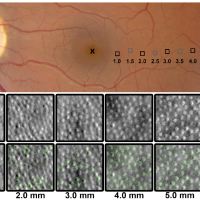
NEI researchers have created the largest known database providing a reference for the size of individual cone photoreceptors, the cells in the retina responsible for color vision, across the lifespan.
In the 21st century, biomedical science is increasingly based on “big data”. The National Institutes of Health (NIH) is aiming to ensure that researchers who generate and share high-quality datasets receive recognition.
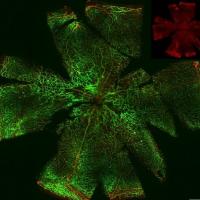
NEI-funded research at Duke University used induced pluripotent stem cells (iPSCs) to grow specialized blood vessel cells critical to retinal health for the first time.
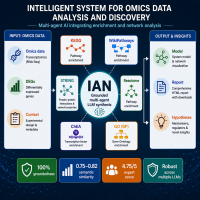
Vision scientists have developed an AI system that can rapidly analyze large-scale gene expression data and generate clear, biologically meaningful explanations.
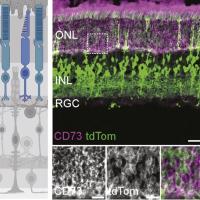
A new understanding of retinal cell development may help pave the way for future retina transplants, which could restore sight to people whose conditions currently have no effective treatments
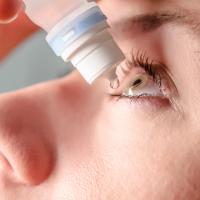
National Eye Institute-funded research at the University of Pittsburgh School of Medicine showed that an early-stage, experimental “living eye drop” that uses naturally occurring eye bacteria supports corneal wound healing.
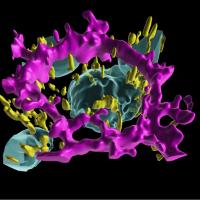
National Eye Institute (NEI) researchers have developed a digital replica of crucial eye cells, providing a new tool for studying how the cells organize themselves when they are healthy and affected by diseases.
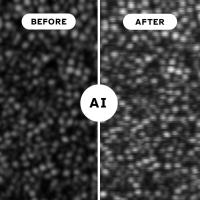
Getting the most advanced ophthalmic imaging technologies into the hands of healthcare providers will vastly improve the ability to detect retinal diseases earlier, and guide treatments to prevent vision loss.
Ten teams are being recognized for their proof-of-concept ideas following Phase 1 of the Data Sharing Index (“S-Index”) Challenge, an NIH competition aimed at incentivizing data sharing