Los Institutos Nacionales de la Salud (NIH) están posponiendo el lanzamiento de su nuevo sitio web hasta el otoño para garantizar la mejor experiencia posible para todas las personas que utilizan nuestros sitios web para obtener información sobre la salud, investigación, oportunidades de financiamiento y otros recursos. Consulta las últimas actualizaciones y las preguntas frecuentes (disponibles en inglés).
Thanks to the work of NEI scientists and grantees, we’re constantly learning new information about the causes and treatment of vision disorders. Get the latest updates about their work — along with other news about NEI.
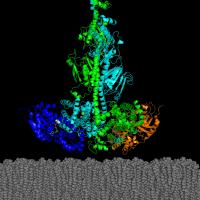
Researchers at the University of New Hampshire have reported the first structural model for a key enzyme, and its activating protein, that can play a role in some genetically inherited eye diseases like retinitis pigmentosa and night blindness.
Researchers at the National Eye Institute (NEI) are launching a clinical trial to test the safety of a novel patient-specific stem cell-based therapy to treat geographic atrophy, the advanced “dry” form of age-related macular degeneration.
In a recent study using mice, lab-grown human retinal cells and patient samples, Johns Hopkins Medicine scientists say they found evidence of a new pathway that may contribute to degeneration of the light sensitive tissue at the back of the eye.
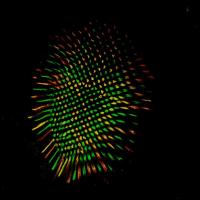
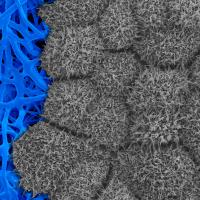
Researchers used artificial intelligence (AI) to evaluate stem cell-derived “patches” of retinal pigment epithelium (RPE) tissue for implanting into the eyes of patients with age-related macular degeneration (AMD), a leading cause of blindness.
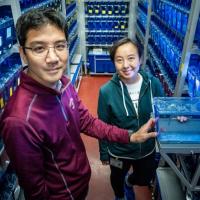
Researchers studying zebrafish have found that genes linked to autism spectrum disorder and other developmental brain abnormalities may be playing a role in people who cannot control their eye movements.
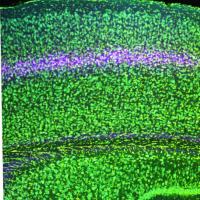
Researchers at Baylor College of Medicine and the University of Tübingen in Germany have developed a novel computational approach to finding stimuli that neurons in the brain ‘like.’