
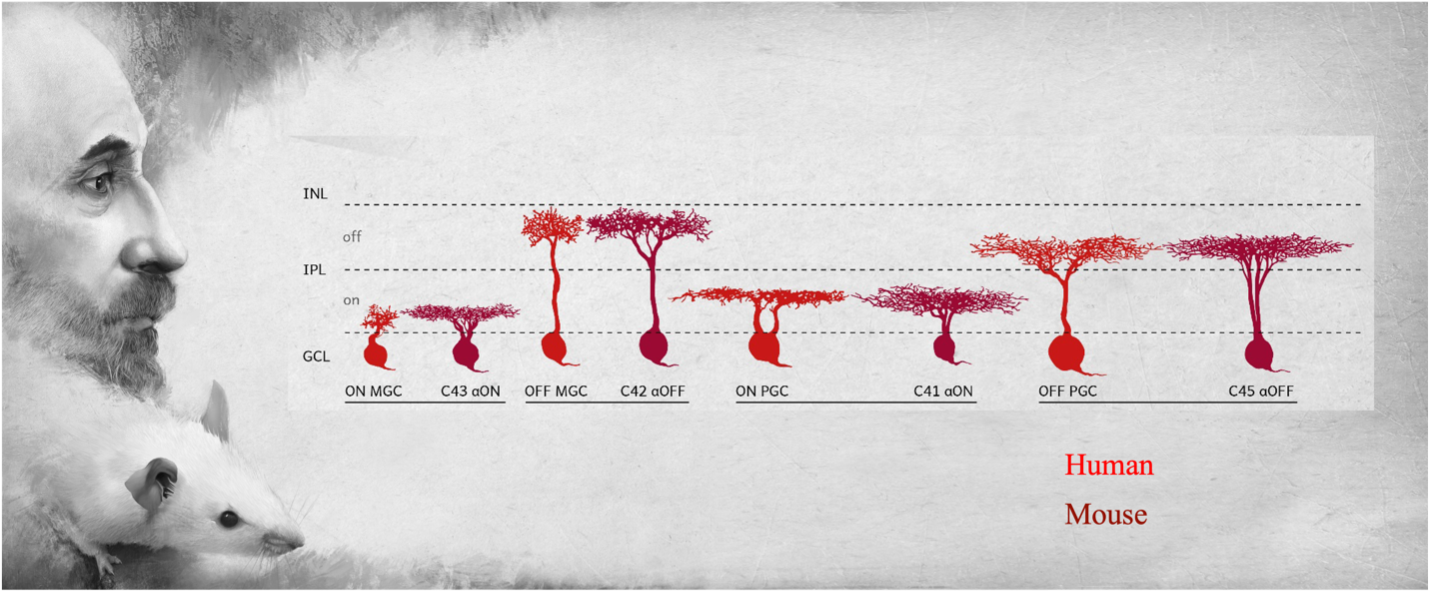
The retina of vertebrate species, such as mice and humans, are remarkably conserved since the origin of jawed vertebrates more than 400 million years ago. This diagram shows the similarities between the retinal cells of humans and mice, including the ON and OFF “midget” retinal ganglion cells (MGCs). Illustration by Hugo Salais, Metazoa Studio, Spain.
Karthik Shekhar and his colleagues raised a few eyebrows as they collected cow and pig eyes from Boston butchers, but those eyes — eventually from 17 separate species, including humans — are providing insights into the evolution of the vertebrate retina and could lead to better animal models for human eye diseases.
In a comparative analysis across animals of the many cell types in the retina — mice alone have 130 types of cells in the retina, as Shekhar’s previous studies have shown — the researchers concluded that most cell types have an ancient evolutionary history. These cell types, distinguished by their differences at the molecular level, give clues to their functions and how they participate in building our visual world.
Their remarkable conservation across species suggests that the retina of the last common ancestor of all mammals, which roamed the earth some 200 million year ago, must have had a complexity rivaling the retina of modern mammals. In fact, there are clear hints that some of these cell types can be traced back more than 400 million years ago to the common ancestors of all vertebrates — that is, mammals, reptiles, birds and jawed fish.
The results were published Dec. 13 in the journal Nature as part of a 10-paper package reporting the latest results of the BRAIN Initiative Cell Census Network's efforts to create a cell-type atlas of the adult mouse brain.
The team's new detailed map of cell types in a variety of vertebrate retinas could aid research on human eye disease.