
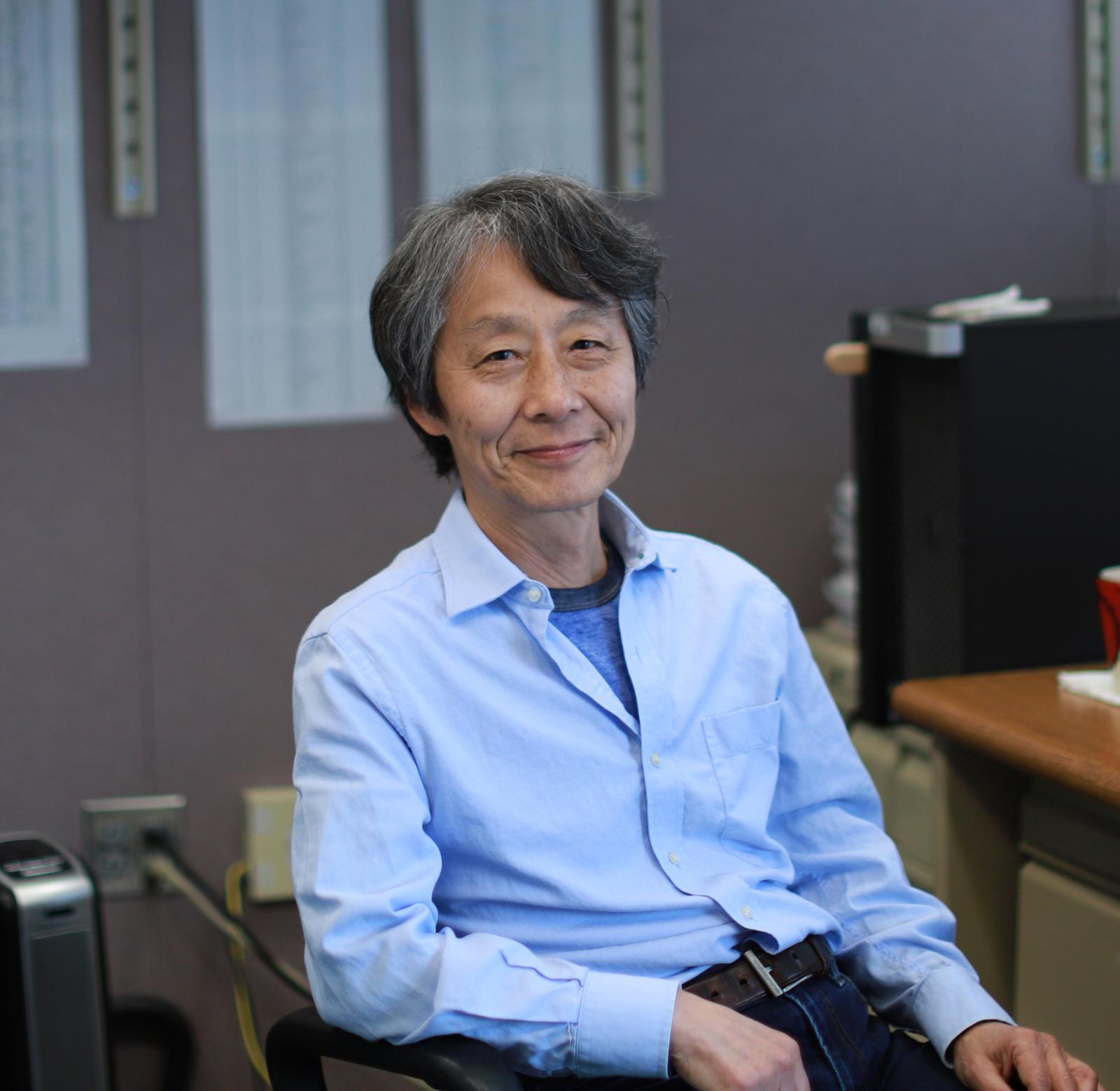
Okihide Hikosaka, Ph.D.
The National Academy of Sciences elected to its membership Okihide Hikosaka, Ph.D., who served as distinguished investigator in the Laboratory of Sensorimotor Research (LSR) at the National Eye Institute until his retirement in 2024.
The election honors Hikosaka for his pioneering research on the basal ganglia, regions of the brain involved with movement and learning. Throughout his career, Hikosaka discovered complex neural pathways through the basal ganglia that play crucial roles in processing visual information and in governing movement, including eye movement. His work has fundamentally changed the understanding of how the brain transforms sensory information and reward expectations into physical actions.
Among his many contributions, Hikosaka discovered that a part of the basal ganglia called the substantia nigra pars reticulata provides tonic inhibition to the superior colliculus. He showed that eye movements are triggered by a quick release of this inhibition.
He was also the first to show motivational functions of the lateral habenula, an important anti-reward structure of the brain. He showed that its neurons signal negative reward information, firing when a reward is withheld.
He also identified parallel circuits for different types of learning, skills and habit formation.
The implications of his research have opened new avenues for understanding and developing treatments for Parkinson’s disease, depression and schizophrenia.
Gaby Costello, Ph.D., a scientist with the National Institute of Neurological Disorders and Stroke (NINDS) who worked with Hikosaka as a postdoc at NEI's LSR praised his mentorship and contributions to the field. “I could not have asked for a better mentor, and his influence on science and on the many people he has trained will continue for generations,” she said.
“He was always seeking to understand what the brain was teaching us at the level of neural circuits. He inspired us to think big and outside the box, with curiosity and passion. For all his brilliance as a scientist, he is deeply humble, kind, and thoughtful. His focus has always been on discovery and the pursuit of science.”
Hikosaka joined NIH in 1979 as a postdoctoral fellow working with Robert Wurtz, Ph.D., the founding chief of LSR. Hikosaka then served as chief of the Neuronal Networks Section at LSR, where he later served as a distinguished investigator from 2002 to 2024. He retired from NIH in December 2024.
Hikosaka’s election to the NAS follows other major recognitions, including being named a 2024 Citation Laureate and receiving the 2018 Gruber Prize in Neuroscience.
To learn more about his work, watch “Okihide Hikosaka: Neuronal Circuits Related to Emotion,” https://www.youtube.com/watch?v=AVHnQzalCiQ