
Image credit: Hirofumi Morishita, Mount Sinai Health System
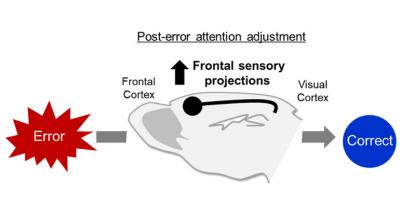
Mount Sinai researchers have identified a neural pathway through which the brain detects errors and guides subsequent behavioral improvement. This process, called cognitive control, is frequently dysregulated in a wide range of psychiatric disorders. The team’s research, published February 19 in Neuron, also suggests that neurostimulation of this brain pathway could provide an important mechanism for attention adjustments following behavioral errors.
“Deficits in error monitoring and attentional function are common to many psychiatric problems, including schizophrenia, ADHD, and autism spectrum disorder, but little is known about the specific neural pathways that are linking these processes,” says senior author Hirofumi Morishita, MD, PhD, Icahn School of Medicine at Mount Sinai.