NIH is moving the launch of its new website to the fall to ensure the best possible experience for everyone who relies on our websites for health information, research, funding opportunities, and other resources. Get the Latest Updates and FAQs
Thanks to the work of NEI scientists and grantees, we’re constantly learning new information about the causes and treatment of vision disorders. Get the latest updates about their work — along with other news about NEI.
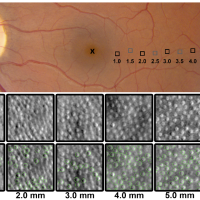
NEI researchers have created the largest known database providing a reference for the size of individual cone photoreceptors, the cells in the retina responsible for color vision, across the lifespan.
Getting the most advanced ophthalmic imaging technologies into the hands of healthcare providers will vastly improve the ability to detect retinal diseases earlier, and guide treatments to prevent vision loss.
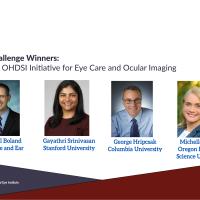
Four teams have won a prize competition aimed at integrating eye care and ocular imaging data into studies using large healthcare datasets in biomedical research.
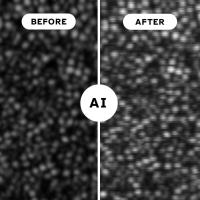
Scientists at the National Institutes of Health (NIH) have leveraged artificial intelligence to transform a device designed to see tissues in the back of the eye into one sharp enough to make out individual cells.
Researchers used an imaging technology called adaptive optics to identify rare cells that could help fill in the gaps in existing theories of color perception.
Researchers at the National Institutes of Health applied artificial intelligence (AI) to a technique that produces high-resolution images of cells in the eye. They report that with AI, imaging is 100 times faster and improves image contrast 3.5-fold.
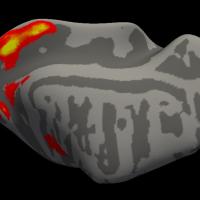
Researchers have found that in dogs, fMRI can detect brain responses to daylight vision for black and white information as well as color information, and identify the area of the visual cortex that responds to stimulation of a cone-rich retinal region.
Research funded by the National Eye Institute suggests that low density of pigment in the macula, the region of the retina required for sharp central vision, is associated with thinning of the retina and may serve as an early warning sign of glaucoma.