Skip to content

NEI Research News

Thanks to the work of NEI scientists and grantees, we’re constantly learning new information about the causes and treatment of vision disorders. Get the latest updates about their work — along with other news about NEI.

Source
296 items

Researchers study how brains remember multiple things at once

Research funded by the National Eye Institute offers insight into what is happening in our brains when our working memory must use its limited resources to remember multiple things.
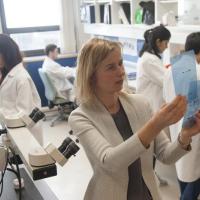
Scientist examines Western blots in the laboratory.

Novel stem cell therapy repairs irreversible corneal damage in clinical trial

A clinical trial that tested an experimental stem cell treatment for blinding cornea injuries found the treatment was feasible and safe in 14 patients, and there was a high proportion of complete or partial success.
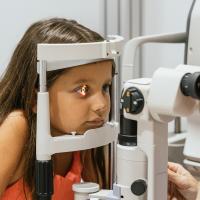
Doctor examines child's eye with a slit lamp.

Treatment pause leads to high rate of relapse in children with a type of autoimmune eye inflammation

According to a National Institutes of Health (NIH)-funded clinical study, children with a type of autoimmune arthritis and associated eye inflammation are likely to experience disease recurrence when discontinuing a biologic therapy called adalimumab.
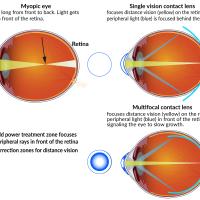
A myopic eye grows too long from front to back. Light gets focused in front of the retina. Single-vision contact lenses focus distance vision on the retina, but peripheral light is focused behind the retina. Multifocal contact lenses focus distance vision on the retina and peripheral light in front of the retina, signaling the eye to slow growth.Multifocal contact lenses are concentric circles consisting of an add power treatment zone in the outer rings that focuses peripheral rays in front of the retina.

Contact lenses used to slow nearsightedness in youth have a lasting effect

In a follow up study, researchers found that children who wore special contact lenses to slow progression of myopia maintained the treatment benefit even after they stopped wearing the contacts as older teens.

NIH-led scientific team defines elements of brain-based visual impairment in children

Experts convened by the National Institutes of Health (NIH) have identified five elements of a brain-based condition that has emerged as a leading cause of vision impairment starting in childhood in the United States and other industrialized nations.

Flagship AI-ready dataset released in type 2 diabetes study

Researchers today are releasing the flagship dataset from an ambitious study of biomarkers and environmental factors that might influence the development of type 2 diabetes, which is associated with a range of eye diseases such as diabetic retinopathy..
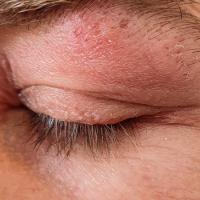
shingles eye

Long-term, low-dose antiviral treatment benefits patients with eye disease and pain from shingles

New research suggests long-term, low-dose antiviral treatment reduces the risk for potentially vision-damaging bouts of shingles-related eye inflammation, infection, and pain.
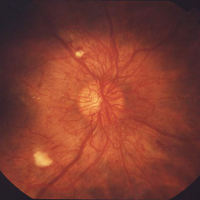
Ophthalmic images from the study probands exhibit variable forms of retinal dystrophy as shown on fundus photos, fundus autoflorescence and optical coherence tomography.

Scientists discover gene responsible for rare, inherited eye disease

Scientists at the National Eye Institute and their colleagues have identified a gene responsible for some inherited retinal diseases (IRDs), which are a group of disorders that damage the eye’s light-sensing retina and threatens vision.
Three surgeons conducting eye surgery in a small room.

Two common surgeries equally effective for treating blinding condition of the eyelid

Trachomatous trichiasis can successfully be treated by either of the two most common types of eyelid surgery, according to findings from a large comparison trial funded by the National Institutes of Health.
Bloodshot eye

The latest mpox outbreak and its threat to vision

NIH-funded investigators break down what is known about the virus' effect on the eye and management of ocular infections