Beginning in late July, NIH will start introducing a new website experience designed to make it easier to find health information, research, funding opportunities, and other resources. During the transition, you may notice changes to navigation, page layouts, and where some information is located. Learn more in our Frequently Asked Questions.
Thanks to the work of NEI scientists and grantees, we’re constantly learning new information about the causes and treatment of vision disorders. Get the latest updates about their work — along with other news about NEI.
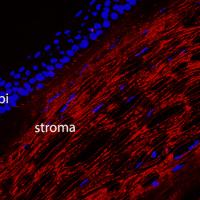
Three-dimensional, lab-grown “mini-corneas” resemble the developing human cornea, making them a powerful new tool for the study of corneal diseases, a study finds.
Researchers at the University of North Texas Health Science Center are the first to characterize extracellular vesicles in the tears of patients with keratoconus.
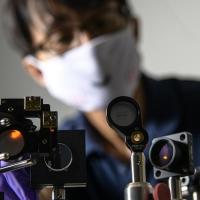
Biomedical engineering and optical sciences professor DK Kang is developing a way to diagnose and treat corneal ulcers that's eight times cheaper and 20 times faster than today's gold standard.
Researchers have developed a new gene therapy that could eventually provide an alternative treatment for Fuchs’ endothelial corneal dystrophy, a genetic eye disease affecting roughly one in 2,000 people globally.
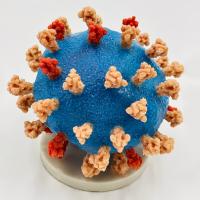
A multi-institutional study finds that COVID-19 can be found in post-mortem corneal tissue, highlighting the importance of the donor screening process.
New findings from researchers at Washington University School of Medicine in St. Louis suggest the eye’s cornea can resist infection from the novel coronavirus.
Harvard Medical School surgeons at Massachusetts Eye and Ear have replaced the ocular surface of four patients who each experienced chemical burns to one eye.
The molecular changes that lead to Fuchs’ endothelial corneal dystrophy (FECD) occur decades before the disease causes blurry vision and other noticeable symptoms in patients, new research by UT Southwestern scientists shows.
A species of a lipid that naturally helps skin injuries heal appears to also aid repair of common corneal injuries, even when other conditions, like diabetes, make healing difficult, scientists report.