Thanks to the work of NEI scientists and grantees, we’re constantly learning new information about the causes and treatment of vision disorders. Get the latest updates about their work — along with other news about NEI.
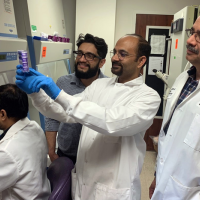
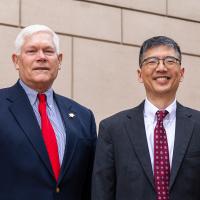
Texas Congressman Pete Sessions visited the NIH March 27 to meet with NEI Director Michael F. Chiang, M.D., and to tour NEI’s Section on Ocular and Stem Cell Translational Research, led by Kapil Bharti, Ph.D.
A National Eye Institute-led team has identified a compound already approved by the U.S. Food and Drug Administration that keeps light-sensitive photoreceptors alive in three models of Leber congenital amaurosis type 10 (LCA 10).
New UCLA research in mice suggests that “dormant” cone photoreceptors in the degenerating retina are not dormant at all, but continue to function, producing responses to light and driving retinal activity for vision.
Using vision to efficiently move through an area by foot uses a unique region of the brain’s cortex, according to a small study funded by the National Eye Institute (NEI).
UVA Health scientists have discovered an unknown contributor to harmful blood vessel growth in the eye that could lead to new treatments for blinding macular degeneration and other common causes of vision loss.
Researchers at the University of North Texas Health Science Center are the first to characterize extracellular vesicles in the tears of patients with keratoconus.
In a study from the Picower Institute at MIT, the first detailed mapping and modeling of thalamus inputs onto visual cortex neurons show brain leverages “wisdom of the crowd” to process sensory information.