Thanks to the work of NEI scientists and grantees, we’re constantly learning new information about the causes and treatment of vision disorders. Get the latest updates about their work — along with other news about NEI.
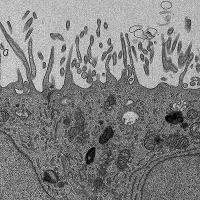
NEI-funded research at Scripps Research Institute has turned up more than a dozen gene variants linked to MacTel, a rare eye disease. The variants are likely causing the condition to develop and worsen for a significant share of patients.
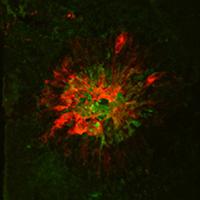
The latest research from the John A. Moran Eye Center reveals how an oxidized form of cholesterol can change choroidal endothelial cells into cells that become scars and may wreak havoc in the eyes of age-related macular degeneration (AMD) patients.
Scientists at the University of Utah have invented a method for synthesizing large enough quantities of very-long-chain polyunsaturated fatty acids (VLC-PUFAs) to evaluate their potential sight-preserving properties.
Scientists at the National Eye Institute (NEI) have developed a promising gene therapy strategy for a rare disease that causes severe vision loss in childhood.
In experiments in mouse tissues and human cells, Johns Hopkins Medicine researchers say they have found that removing a membrane that lines the back of the eye may improve the success rate for regrowing nerve cells damaged by blinding diseases.
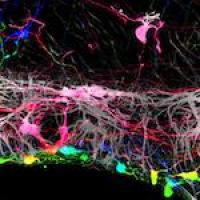
A team of scientists have created a molecular catalog that describes the different types of retinal ganglion cells in zebrafish, linking them to specific connections, functions, and behaviors.
Surgical and injectable drug approaches are equally effective for treatment of bleeding inside the eye from proliferative diabetic retinopathy (PDR), according to a National Eye Institute (NEI)-supported clinical study from the DRCR Retina Network .
A new study shows that deleting one of the inhibitors of the RPE65 gene in a mouse model that carries a human disease mutation prevents degeneration of cone photoreceptors that are used for daytime high-resolution color vision.
Scientists at Scripps Research have uncovered a potential new strategy for treating eye diseases that affect millions of people around the world, often resulting in blindness.