Skip to content

NEI Research News

Thanks to the work of NEI scientists and grantees, we’re constantly learning new information about the causes and treatment of vision disorders. Get the latest updates about their work — along with other news about NEI.

Source
237 items

LSU Health New Orleans Discovers Drug Development Target for Retinal Dystrophies

A new study shows that deleting one of the inhibitors of the RPE65 gene in a mouse model that carries a human disease mutation prevents degeneration of cone photoreceptors that are used for daytime high-resolution color vision.

New strategy for treating common retinal diseases shows promise

Scientists at Scripps Research have uncovered a potential new strategy for treating eye diseases that affect millions of people around the world, often resulting in blindness.
Samarendra Mohanty and Subrata Batabyal

Scientists use gene therapy and a novel light-sensing protein to restore vision in mice

A newly developed light-sensing protein called the MCO1 opsin restores vision in blind mice when attached to retina bipolar cells using gene therapy.
NEI Audacious Goals Initiative for regenerative medicine in vision identity mark

Eye institute’s audacious quest: What once was lost might now be regrown

The National Eye Institute (NEI) Audacious Goals Initiative (AGI) is exploring the possibility that the natural world holds the keys to restorative therapies that might unlock regenerative powers in humans.

OMRF discovery holds potential for reversing vision loss

Oklahoma Medical Research Foundation scientists have identified a compound that could give birth to therapies for a host of eye diseases that include retinopathy of prematurity and diabetic retinopathy.
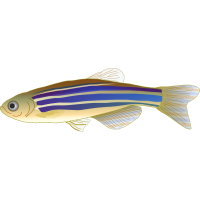
Zebrafish

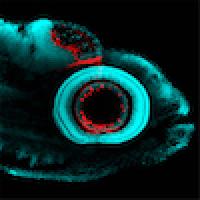
Could a tiny fish hold the key to curing blindness?

NEI-funded scientists are hacking the zebrafish’s innate regenerative capacity to learn how to treat human disease.
City scene at night. Credit: Luca Bravo on Unsplash

How is night vision maintained during retinal disease?

New research from the University of Utah provides insight on how people with retinal degenerative disease can maintain their night vision for a relatively long period of time.
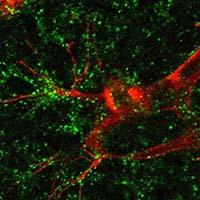
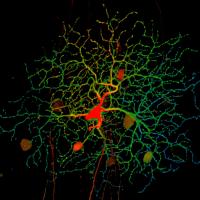
Retinal ganglion cell with a red cell body and green axons spread out over a large area

Real neurons are noisy. Can a retinal prosthetic figure that out?

The brain’s visual centers must be adept at filtering out noise from retinal cells to get to the true signal, and those filters have to constantly adapt. Prosthetic retinas are going to need this same filtering to succeed, NEI-funded research shows.
Retina flattened to 4 lobes, stained yellow and blue

LSU Health show nonharmful stress protects against disease in offspring

Researchers funded by the National Eye Institute show in a mammalian model the reprogramming of heritability to promote disease resilience in the next generation.
Cut into 3D volume displaying flat pattern of round cells

Seeing the eye like never before

Scientists at the University of Washington School of Medicine detect minute changes in response to light in photoreceptors in a living eye.