Skip to content

NEI Research News

Thanks to the work of NEI scientists and grantees, we’re constantly learning new information about the causes and treatment of vision disorders. Get the latest updates about their work — along with other news about NEI.

Source
234 items
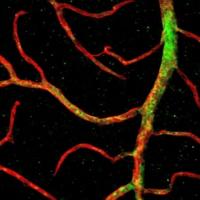
Mouse retinal blood vessels

‘Primitive’ Stem Cells Shown to Regenerate Blood Vessels in The Eye

Researchers turn back the biological hands of time, making adult cells revert to a primitive state with the potential to replace and repair retinal blood vessels.
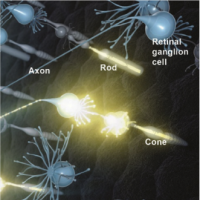
Artist’s rendering of neural activity in the retina. Light that enters the eye activates rod and cone photoreceptors, which then activates retinal ganglion cells. A signal travels to the brain via the retinal ganglion cell axons. Photo credit: National Eye Institute

Let there be 'circadian' light

Researchers at UW Medicine have decoded what makes good lighting – lighting capable of stimulating the cone photoreceptor inputs to specific neurons in the eye that regulate circadian rhythms.
Brad Gelfand, Ph.D., in the laboratory

Potential Way to Halt Blinding Macular Degeneration Identified

Researchers at the University of Virginia have successfully treated age-related macular degeneration (AMD) in mice after finding an unexpected link between the two main forms of the blinding eye disease.
Research team at Virginia Tech

Fralin Biomedical Research Institute scientists shed light on surprising visual development patterns

In a new study from Virginia Tech, neuroscientists reveal a surprising clue about how the intricate visual processing system forms during early brain development.
Fly eye in red, green and yellow

How Do Fruit Flies See in Color?

Study from Columbia University uncovers human-like brain circuit at work. Their findings lay the groundwork for mapping mechanisms of color vision.
Grantee News

LSU Health discovers critical role of two proteins in vision and preventing blinding eye diseases

LSU researchers have discovered unique patterns of genetic activity that may lead to the development of blinding retinal diseases.
Blood vessels in the retina

Helper protein worsens diabetic eye disease

In a recent study using mice, lab-grown human retinal cells and patient samples, Johns Hopkins Medicine scientists say they found evidence of a new pathway that may contribute to degeneration of the light sensitive tissue at the back of the eye.
Image of scanning electron micrograph

NIH, NIST researchers use artificial intelligence for quality control of stem cell-derived tissues

Researchers used artificial intelligence (AI) to evaluate stem cell-derived “patches” of retinal pigment epithelium (RPE) tissue for implanting into the eyes of patients with age-related macular degeneration (AMD), a leading cause of blindness.
Grantee News

Success of gene therapy for a form of inherited blindness depends on timing

Using a canine model of the vision disorder Leber congenital amaurosis, Penn researchers found that photoreceptor cells continue to deteriorate after treatment if it is given too late.
Grantee News

Disruption of glucose transport to rods and cones shown to cause vision loss in retinitis pigmentosa

Retinitis pigmentosa (RP) is a common hereditary eye disorder that leads to the gradual deterioration of rod cells causing reduced peripheral vision and night vision. Subsequent loss of cone photoreceptors cause the loss of high-resolution daylight...