Thanks to the work of NEI scientists and grantees, we’re constantly learning new information about the causes and treatment of vision disorders. Get the latest updates about their work — along with other news about NEI.
A new form of therapy may halt or even reverse a form of progressive vision loss, spinocerebellar ataxia type 7 (SCA7). This new therapy has the potential to treat neurogenetic diseases effectively and with far fewer side effects than other medications.
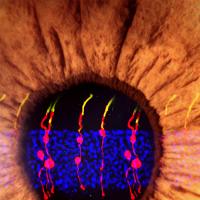
Researchers funded by the National Eye Institute (NEI) have reversed congenital blindness in mice by changing supportive cells in the retina called Müller glia into rod photoreceptors.
Inspired by tiny nanostructures on transparent butterfly wings, engineers at Caltech have developed a synthetic analogue for eye implants that makes them more effective and longer-lasting.
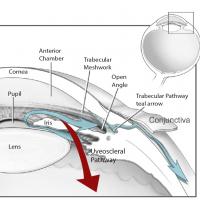
The recent approval of two novel medications for glaucoma – the first new medications for the disorder in nearly 18 years – are fruit borne from decades of foundational scientific research supported by the National Eye Institute (NEI).
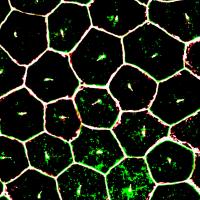
Scientists at the National Eye Institute (NEI) report that tiny tube-like protrusions called primary cilia on cells of the retinal pigment epithelium (RPE) are essential for the survival of the retina’s light-sensing photoreceptors.
A new report outlines steps to bringing future regenerative therapies for blinding diseases of the retina to patients. The retina is the light-sensitive tissue in the back of the eye. When stimulated, retinal neurons send visual information to the brain.
A new report gives recommendations for regenerating retinal ganglion cells (RGCs), crucial neurons in the back of the eye that carry visual information to the brain.