Thanks to the work of NEI scientists and grantees, we’re constantly learning new information about the causes and treatment of vision disorders. Get the latest updates about their work — along with other news about NEI.
The Knights Templar Eye Foundation has awarded two NEI scientists grants to research inherited retinal degenerations, diseases that can cause blindness in early childhood.
A new study shows that the complement system, part of the innate immune system, plays a protective role to slow retinal degeneration in a mouse model of retinitis pigmentosa, an inherited eye disease.
Johns Hopkins Medicine researchers report they have created a method of mapping how the central nervous system develops by tracking the genes expressed in cells.
Johns Hopkins Medicine scientists say that new experiments with mouse eye tissues strongly suggest that a longstanding “textbook concept” about the way a mammal’s retina processes light needs a rewrite.
A research team at Massachusetts Eye and Ear has shown that microglia, the primary immune cells of the central nervous system—including the retina of the eye—serve as “gatekeepers,” or biosensors and facilitators, of neuroinflammation...
Eating a calcium-rich diet or taking calcium supplements does not appear to increase the risk of age-related macular degeneration (AMD), according to the findings of a study by scientists at the National Eye Institute (NEI).
A new therapy developed by researchers at the University of California, Berkeley, could help prolong useful vision and delay total blindness for people with retinitis pigmentosa.
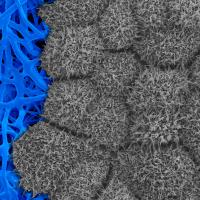
Cells of the retinal pigment epithelium (RPE) form unique patterns that can be used to track changes in this important layer of tissue in the back of the eye, researchers at the National Eye Institute (NEI) have found.
A team of researchers led by Harvard's Joshua Sanes applied high-throughput genetic sequencing methods to create the first cellular atlas of the primate retina.
National Eye Institute scientists led a collaborative study and zeroed in on genes associated with age-related macular degeneration (AMD), a leading cause of vision loss and blindness among people age 65 and older.