Thanks to the work of NEI scientists and grantees, we’re constantly learning new information about the causes and treatment of vision disorders. Get the latest updates about their work — along with other news about NEI.
NEI research fellow Nathan Hotaling, PhD, has been awarded a $65,000 grant from the Knights Templar Eye Foundation to develop a stem cell-based system to study Best disease, a genetic disorder that can cause progressive vision loss.
Columbia University Medical Center (CUMC) and University of Iowa scientists have used a new gene-editing technology called CRISPR to repair a genetic mutation responsible for retinitis pigmentosa (RP), an inherited condition.
A new technique that has the potential to treat inherited diseases by removing genetic defects has been shown for the first time to hinder retinitis pigmentosa, a degenerative eye disease with no known cure that can lead to blindness.
Retinal implants that deliver longer pulses of electrical current may noticeably improve image sharpness for individuals who have lost their sight due to retinitis pigmentosa, according to a new study.
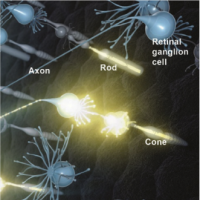
Johns Hopkins researchers have developed a method to efficiently turn human stem cells into retinal ganglion cells, the type of nerve cells located within the retina that transmit visual signals from the eye to the brain.
Gene therapy preserved vision in a study involving dogs with naturally occurring, late-stage retinitis pigmentosa, according to research funded by the National Eye Institute (NEI), part of the National Institutes of Health.
Researchers funded by the National Institutes of Health have developed a novel mouse model for the vision disorder Leber hereditary optic neuropathy (LHON), and found that they can use gene therapy to improve visual function in the mice.
Loss or defects of a protein previously shown to play a key a role in cataract, the clouding of the lens that commonly strikes people in their seventies, has now been shown to contribute to presbyopia.
Five bold projects will develop new technology to noninvasively image cells of the eye in unprecedented detail.The National Eye Institute (NEI) announced the awards as part of its Audacious Goals Initiative.