Skip to content

NEI Research News

Thanks to the work of NEI scientists and grantees, we’re constantly learning new information about the causes and treatment of vision disorders. Get the latest updates about their work — along with other news about NEI.

Source
296 items
Grantee News

Eye conditions provide new lens for screening for Alzheimer’s

Researchers from the University of Washington find link between certain eye conditions and the risk for Alzheimer's disease.
Grantee News

Immune Response Likely Culprit in Eyelid Gland Condition That Causes Dry Eye

Mouse, human data suggest inflammation tips immune response, which disrupts oil glands.
Glaucoma causes the loss of peripheral vision. This photo shows two boys in the center surrounded by blackness to depict the tunnel vision that can occur as the disease progresses.

NEI funded researchers identify 133 genetic variants that predict glaucoma risk

Researchers funded by the National Eye Institute (NEI) have identified 133 genetic variants that predict with 75-percent accuracy a person’s risk for developing glaucoma related to elevated pressure within the eye.
capsules

Omega-3s from fish oil supplements no better than placebo for dry eye

Omega-3 fatty acid supplements taken orally proved no better than placebo at relieving symptoms or signs of dry eye, according to the findings of a well-controlled trial funded by the National Eye Institute (NEI), part of the National Institutes of Health
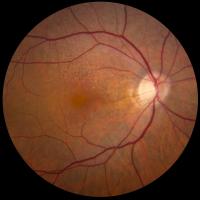
A fundus photo of a patient with reticular pseudodrusen shows a giraffe-like macular pattern.

NIH launches international study of AMD progression

A new clinical study led by the National Eye Institute (NEI), part of the National Institutes of Health, will follow 500 people over five years to learn more about the natural history of early age-related macular degeneration (AMD).
Driving simulators enable researchers to study potentially dangerous driving situations

Low vision research shifts into overdrive

Tim Goetz drives about 200,000 miles each year. Remarkably, Goetz is legally blind.
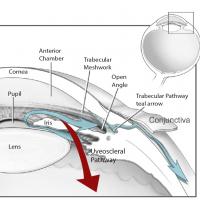
Aqueous humor flows out of the anterior chamber through the open angle where the cornea meets the iris. The open angle consists of two routes: the conventional, trabecular pathway, which includes a spongy layer called the trabecular meshwork, and the non-conventional, uveoscleral pathway, through the ciliary muscle that controls the eye’s focusing mechanism. The majority of fluid flows out via the trabecular pathway, which acts like a one-way valve. About a third of the fluid exits through the uveoscleral p

NEI support paved early pathway for novel glaucoma therapies

The recent approval of two novel medications for glaucoma – the first new medications for the disorder in nearly 18 years – are fruit borne from decades of foundational scientific research supported by the National Eye Institute (NEI).
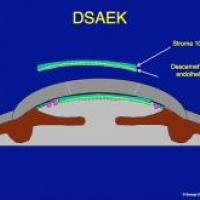
DSAEK Corneal transplantation

NIH study finds donor corneas can be safely preserved for longer period

Results from a large, national clinical trial show that corneal donor tissue can be safely stored for 11 days without negatively impacting the success of transplantation surgery to restore vision in people with diseases of the cornea.
patient and doctor smiling

Participation in clinical trials improves diabetes care

The development of new therapies and cures would be impossible without patients volunteering for clinical research studies.
Eye chart with "myopia" in focus

Myopia: A close look at efforts to turn back a growing problem

Several studies indicate that the prevalence of myopia is increasing in the U.S. and worldwide, and researchers project that the trend will continue in the coming decades.