Skip to content

NEI Research News

Thanks to the work of NEI scientists and grantees, we’re constantly learning new information about the causes and treatment of vision disorders. Get the latest updates about their work — along with other news about NEI.

Source
472 items

How do our eyes stay focused on what we reach for? Researchers uncover how our gaze is “anchored” in the brain

Findings offer new insights into how our movements are coordinated
Image of Cortical neurons

Scientists unveil the format of working memory

A team of scientists has discovered how working memory is “formatted”—a finding that enhances our understanding of how visual memories are stored.
Cells of fruit fly visual system stained in rainbow colors

Scientists pinpoint what makes brain cells develop in a specific order

A study of the visual system of fruit flies reveals factors regulating neuron development and uncovers similarities with human brain development

Decoding the molecular clock that controls neurogenesis in the visual center of Drosophila

The nervous system is made up of diverse cells that arise from progenitors in a specific time-dependent pattern. In a new study, researchers have uncovered the molecular players involved and how the timing is controlled.
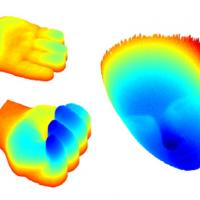
3D colorized images of open and closed hand, and a face

How eye imaging technology could help robots and cars see better

Duke researchers demonstrate how a few tricks learned from their OCT research can improve on LIDAR, a technology used for vision in self-driving cars.
Three soccer players on a field. Center player looks down at the ball by her feet.

Attention to objects in peripheral vision is not driven by tiny eye movements

New research by National Eye Institute (NEI) investigators shows that while microsaccades seem to boost or diminish the strength of the brain signals underlying attention, eye movements are not drivers of those brain signals.
two people are taking a walk outside

Seen and ‘herd’: Collective motion in crowds is largely determined by participants’ field of vision

Researchers at Brown University developed a new model to predict human flocking behavior based on optics and other sensory data.
Dongkyun "DK" Kang

UArizona engineer leads $1M project to fight vision loss

Biomedical engineering and optical sciences professor DK Kang is developing a way to diagnose and treat corneal ulcers that's eight times cheaper and 20 times faster than today's gold standard.
retina blood vessels

Indiana University-led study shows human induced pluripotent stem cells improve visual acuity, vascular health

Researchers improved vision in a type 2 diabetes mouse model by reprogramming blood cells into endothelial cells with vessel reparative properties similar to endothelial colony forming cells.
screen shot of a Zoom meeting

NEI hosts international strategic planning meeting

The digital summit of global partners in vision research discussed opportunities for collaboration.