Skip to content

NEI Research News

Thanks to the work of NEI scientists and grantees, we’re constantly learning new information about the causes and treatment of vision disorders. Get the latest updates about their work — along with other news about NEI.

Source
183 items
Image of gene therapy preserved vision in a study involving dogs.

Gene Therapy Staves Off Blindness from Retinitis Pigmentosa in Canine Model

Gene therapy preserved vision in a study involving dogs with naturally occurring, late-stage retinitis pigmentosa, according to research funded by the National Eye Institute (NEI), part of the National Institutes of Health.
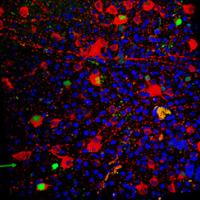
Dr. John Guy and colleagues added a homing signal to a virus in order to deliver the ND4 gene into mitochondria. A marker for the gene is shown in red and the ND4 protein is shown in green, inside retinal ganglion cells in the mouse eye. The nuclei of retinal ganglion cells are shown in blue. Credit: Dr. Hong Yu, Bascom Palmer.

Scientists Test New Gene Therapy for Vision Loss From a Mitochondrial Disease

Researchers funded by the National Institutes of Health have developed a novel mouse model for the vision disorder Leber hereditary optic neuropathy (LHON), and found that they can use gene therapy to improve visual function in the mice.
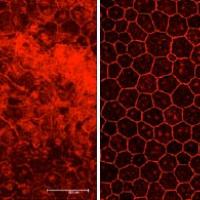
Mice with AQP0 mutations (top) had disorderly fiber cells compared to mice with healthy AQP0.

Defective Lens Protein Implicated in Cataract Shown Culprit in Presbyopia

Loss or defects of a protein previously shown to play a key a role in cataract, the clouding of the lens that commonly strikes people in their seventies, has now been shown to contribute to presbyopia.
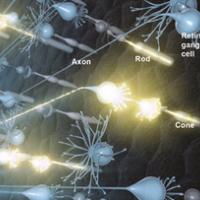
Artist's rendering of neural activity in the retina. Light that enters the eye activates rod and cone photoreceptors, which in turn activate retinal ganglion cells. Signals travel to the brain via retinal ganglion cell axons. Photo credit: National Eye Institute.

NIH Launches Research to Gaze Deeply Into Your Eyes

Five bold projects will develop new technology to noninvasively image cells of the eye in unprecedented detail.The National Eye Institute (NEI) announced the awards as part of its Audacious Goals Initiative.
Grantee News

Stem Cell Injection May Soon Reverse Vision Loss Caused By Age-Related Macular Degeneration

An injection of stem cells into the eye may soon slow or reverse the effects of early-stage age-related macular degeneration, according to new research from scientists at Cedars-Sinai.
Degenerated RPE cells from mice with geographic atrophy are shown at left. Treating the mice with NRTIs protected the RPE cells. Photos courtesy of Jayakrishna Ambati, M.D.

HIV drugs show promise for “dry” AMD

A class of medications long used to curb HIV infection shows promise as a therapy for age-related macular degeneration (AMD), suggest findings from an NIH-funded study.
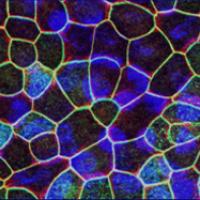
Retinal pigment epithelium derived from induced pluripotent stem cells. Photo credit: Dr. Kapil Bharti.

Gene profiling technique to accelerate stem cell therapies for eye diseases

Researchers at the National Institutes of Health have developed a technique that will speed up the production of stem-cell derived tissues.
Grantee News

Patient-Specific Stem Cells and Personalized Gene Therapy

Columbia University Medical Center (CUMC) researchers have created a way to develop personalized gene therapies for patients with retinitis pigmentosa (RP), a leading cause of vision loss.
Chichilnisky and colleagues used an electrode array to record activity from retinal ganglion cells (yellow and blue) and feed it back to them, reproducing the cells' responses to visual stimulation. Credit: E.J. Chichilnisky, Stanford.

Making artificial vision look more natural

In laboratory tests, researchers have used electrical stimulation of retinal cells to produce the same patterns of activity that occur when the retina sees a moving object.
Grantee News

Researchers Use Human Stem Cells to Create Light-Sensitive Retina in a Dish

Using a type of human stem cell, researchers have created a three-dimensional complement of human retinal tissue in the laboratory, which notably includes functioning photoreceptor cells capable of responding to light