Thanks to the work of NEI scientists and grantees, we’re constantly learning new information about the causes and treatment of vision disorders. Get the latest updates about their work — along with other news about NEI.
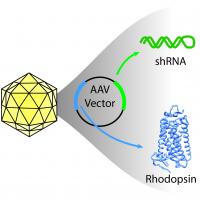
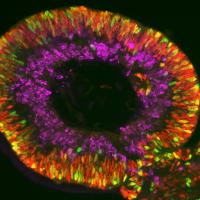
Researchers funded by the National Eye Institute (NEI) have reversed congenital blindness in mice by changing supportive cells in the retina called Müller glia into rod photoreceptors.
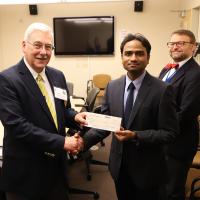
National Eye Institute (NEI) Postdoctoral Fellow Aman George, Ph.D., has received a $65,000 grant from the Knights Templar Eye Foundation to identify new drug treatments for vision impairment in children with a type of albinism.
A competition for radical ideas in the fight against blindness will move to its next phase by challenging participants to build functioning human retina prototypes.
Scientists at the National Eye Institute (NEI) report that tiny tube-like protrusions called primary cilia on cells of the retinal pigment epithelium (RPE) are essential for the survival of the retina’s light-sensing photoreceptors.
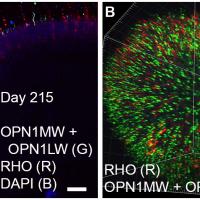
A proposal to create a living model of the human retina, the light-sensitive tissue at the back of the eye, won $90,000 in the National Eye Institute (NEI) 3-D Retina Organoid Challenge (3-D ROC).
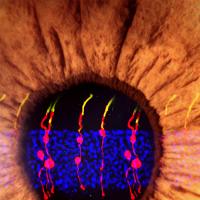
Cells within an injured mouse eye can be coaxed into regenerating neurons and those new neurons appear to integrate themselves into the eye’s circuitry, new research shows.
A solar eclipse will be visible across North America for 2 to 3 hours on Monday, August 21, 2017. Watching the moon slowly block out the sun is a rare opportunity but should be attempted with caution.