
Skip to content

NEI Research News

Thanks to the work of NEI scientists and grantees, we’re constantly learning new information about the causes and treatment of vision disorders. Get the latest updates about their work — along with other news about NEI.

Source
296 items
Patient undergoes and eye exam. Courtesy National Eye Institute.

Age-related macular degeneration before and after the era of anti-VEGF drugs

In a study of nearly 650 people with the eye disease age-related macular degeneration (AMD), half still had vision 20/40 or better after five years of treatment with anti-VEGF drugs that are injected into the eye.
Grantee News

USC Roski Eye Institute Researchers Publish Largest Eye Study Among Chinese Americans Identifying More Effective Ways to Prevent and Treat Blinding Eye Diseases for This Racial Group

Researchers and clinicians at the University of Southern California Roski Eye Institute have published results of the NEI-funded “Chinese American Eye Study” in JAMA Ophthalmology.
Patient undergoes and eye exam. Courtesy National Eye Institute.

Eylea Outperforms Avastin for Diabetic Macular Edema with Moderate or Worse Vision Loss

A two-year clinical trial that compared three drugs for diabetic macular edema (DME) found that gains in vision were greater for participants receiving the drug Eylea (aflibercept) than for those receiving Avastin (bevacizumab).
Moderate hyperopia, if not treated, may affect reading ability and grade school readiness among preschoolers. Credit: Joe Balintfy, NEI.

Uncorrected Farsightedness Linked to Literacy Deficits in Preschoolers

A study funded by the National Eye Institute (NEI), part of the National Institutes of Health, has shown that uncorrected farsightedness (hyperopia) in preschool children is associated with significantly worse performance on a test of early literacy.
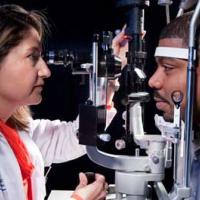
NEI image using a slit lamp

New Treatment Options, Better Hope of Preventing Vision Loss from Diabetes

This National Diabetes Month, there is some good news for people with eye complications from diabetes.
Animation of abnormal blood vessels bleeding into the center of the eye due to proliferative diabetic retinopathy. Photo credit: National Eye Institute. Watch video.

Lucentis Effective for Proliferative Diabetic Retinopathy

A clinical trial funded by the National Institutes of Health has found that the drug ranibizumab (Lucentis) is highly effective in treating proliferative diabetic retinopathy.
Dr. Rachel Bishop and Dr. Allen Eghrari, from the Johns Hopkins University Wilmer Eye Institute, shown here with the advanced imaging technologies being used for the PREVAIL III study in Monrovia, Liberia.

NEI Team in Liberia Investigates Ocular Effects Among Ebola Survivors

Following the 2014 Ebola outbreak in West Africa that took the lives of more than 11,200 people in the region, the National Eye Institute, part of the National Institutes of Health, has deployed a team of clinicians and technical experts to Monrovia...
NIH study raises doubt about any benefits omega-3 and dietary supplements like these may have for cognitive decline. (Photo courtesy of NEI)

NIH Study Shows no Benefit of Omega-3 or Other Nutritional Supplements for Cognitive Decline

While some research suggests that a diet high in omega-3 fatty acids can protect brain health, a large clinical trial by researchers at the National Institutes of Health found that omega-3 supplements did not slow cognitive decline in older persons.
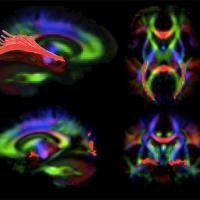
Images of the brain generated by diffusion tensor imaging, a type of MRI. The red highlights show visual pathways in the brain that deteriorate in patients with LCA, but appear to improve with gene therapy to the retina. Credit: Dr. Manzar Ashtari, University of Pennsylvania.

With LCA Gene Therapy, a Rare Glimpse of the Adult Brain Adapting to New Experience

When people lose the ability to see, how do the visual parts of the brain change in response? And if they regain their sight, are the changes reversed?
Children who slept near a cooking fire were four times as likely to develop severe trachoma compared with children who slept in ventilated rooms without cooking fires. This child’s severe trachoma led to loss of vision in his left eye. Photo courtesy of Raul Vasquez/Orbis.

Trachoma Risk Tied to Sleeping Near Cooking Fires, Lack of Ventilation

Children who sleep in unventilated rooms with cooking fires are at greater risk for severe trachoma, a leading cause of preventable blindness in developing countries.