Skip to content

NEI Research News

Thanks to the work of NEI scientists and grantees, we’re constantly learning new information about the causes and treatment of vision disorders. Get the latest updates about their work — along with other news about NEI.

Source
446 items
color blindness comparison

Rosy Health and Sickly Green: Color Associations Play Robust Role in Reading Faces

Anyone who has ever sensed that a person is sick simply by looking at their face has experienced the wealth of information conveyed by face color.
Microglia in retinal sections of a patient with retinitis pigmentosa

Immune System Can Slow Degenerative Eye Disease, NIH-led Mouse Study Shows

A new study shows that the complement system, part of the innate immune system, plays a protective role to slow retinal degeneration in a mouse model of retinitis pigmentosa, an inherited eye disease.
fMRI brain scan shows activity in two different brains

Children’s Brains Reorganize After Epilepsy Surgery to Retain Visual Perception

Children can keep full visual perception – the ability to process and understand visual information – after brain surgery for severe epilepsy, according to a study funded by the National Eye Institute (NEI), part of the National Institutes of Health.
Greens, beans and dairy products arranged on a table

NIH Study Finds No Evidence That Calcium Increases Risk of AMD

Eating a calcium-rich diet or taking calcium supplements does not appear to increase the risk of age-related macular degeneration (AMD), according to the findings of a study by scientists at the National Eye Institute (NEI).
Yellow, red and purple multi-colored mosaic

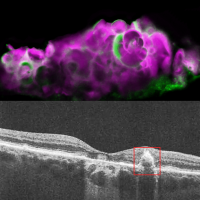
Imaging Method Reveals Long-lived Patterns in Cells of the Eye

Cells of the retinal pigment epithelium (RPE) form unique patterns that can be used to track changes in this important layer of tissue in the back of the eye, researchers at the National Eye Institute (NEI) have found.
Side-by-side photos of trial participant before and after treatment

Nitisinone Increases Melanin in People With Albinism

A small pilot clinical study at the National Eye Institute (NEI) suggests that the drug nitisinone increases melanin production in some people with oculocutaneous albinism type 1B (OCA-1B), a rare genetic disease that causes pale skin and hair and poor vi
Bob Nussenblatt

NEI Remembers Robert “Bob” Nussenblatt (1948-2016)

Robert Nussenblatt, M.D., chief of the Laboratory of Immunology at the National Eye Institute (NEI), died on April 17 at age 67.
Two boys smile at camera. Dark spot in center of image represents vision loss from AMD.

NIH Researchers Home in on Genes Linked to Age-Related Macular Degeneration

National Eye Institute scientists led a collaborative study and zeroed in on genes associated with age-related macular degeneration (AMD), a leading cause of vision loss and blindness among people age 65 and older.
n-Goggle device covering eyes and nose on mannequin head

Glaucoma Detection Gets Potential Boost from Virtual Reality, Brain-Based Device

A wearable brain-based device called NGoggle that incorporates virtual reality could help improve glaucoma diagnosis and prevent vision loss.
Side-by-side panels showing retinal vessels. Left panel filled with green, right panel much less green.

Faulty molecular master switch may contribute to AMD

A signaling pathway controlled by transforming growth factor β (TGF-β) could be involved in the progression of age-related macular degeneration (AMD).