Thanks to the work of NEI scientists and grantees, we’re constantly learning new information about the causes and treatment of vision disorders. Get the latest updates about their work — along with other news about NEI.
Through a clinical collaboration, a 34-year-old paralyzed from the neck down is the first person in the world to have a neural prosthetic device implanted in a region of the brain where intentions are made.
Patients with acquired immunodeficiency syndrome (AIDS) have a four-fold increase in their risk of developing intermediate-stage age-related macular degeneration (AMD) compared to people of the same age who are not infected with HIV.
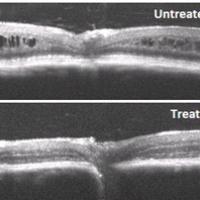
Gene therapy for Leber congenital amaurosis (LCA), an inherited disorder that causes vision loss starting in childhood, improved patients’ eyesight and the sensitivity of the retina within weeks of treatment.
People with type 1 diabetes who intensively control their blood glucose (blood sugar) early in their disease, versus those who do not, are 48 percent less likely to need eye surgery, and the total number of such surgeries is 37 percent less.
Researchers at the University of Michigan and UC Davis have solved a genetic mystery that has afflicted three unrelated families, and possibly others, for generations.
The National Eye Institute (NEI) recently launched the first-ever human gene therapy trial for the vision disorder X-linked retinoschisis (XLRS). Researchers are conducting the trial at the National Institutes of Health Clinical Research Center in...
In an NIH-supported clinical trial comparing three drugs for diabetic macular edema (DME), Eylea (aflibercept) provided greater visual improvement, on average, than did Avastin (bevacizumab) or Lucentis (ranibizumab) when vision was 20/50 or worse.
For some people it feels like a speck of sand in the eye, or stinging or burning that doesn’t go away. For others, dry eye disease (or simply dry eye) can become a chronic condition that leads to blurred vision or even vision loss if it goes untreated.
Depression is a common risk for people who have lost their vision from age-related macular degeneration (AMD), but a new study shows that a type of rehabilitation therapy can cut this risk in half.
Telemedicine is an effective strategy to screen for the potentially blinding disease known as retinopathy of prematurity (ROP), according to a study funded by the National Eye Institute (NEI).