Skip to content

NEI Research News

Thanks to the work of NEI scientists and grantees, we’re constantly learning new information about the causes and treatment of vision disorders. Get the latest updates about their work — along with other news about NEI.

Source
472 items
Map of India

Vision symposium celebrates 15 years of joint India-U.S. research

Members of the Indo-U.S. Vision Research Collaborative Program gathered virtually to look back on the program’s genesis and accomplishments and to plot the program’s future.
Scientists in the laboratory

Retinoblastoma resource: Researchers create more accurate research model

Scientists at St. Jude Children’s Research Hospital have created a laboratory model for studying retinoblastoma driven by inherited mutations in the RB1 gene.
Scientist looking in a microscope

Retina ‘hardwired’ to predict path of moving objects

Neural circuits in the primate retina can generate the information needed to predict the path of a moving object before visual signals even leave the eye, UW Medicine researchers demonstrate in a new paper.
Neurons (green) and their supporting astrocytes (red), created in a petri dish from stem cells.

Cell-replacement Therapies for Visual System Disorders

Two translational studies at the Vanderbilt Eye Institute are targeting photoreceptors and retinal ganglion cells (RGCs) to restore vision through regeneration of the retina. The research is funded by the NEI Audacious Goals Initiative.
Two hat-shaped objects, one pointing towards the viewer (concave) and one away from the viewer (convex)

Scientists uncover how decisions about what we see are relayed back through the brain

Researchers at the National Institutes of Health have discovered that decisions based on visual information is broadcast widely to neurons in the visual system, including to those that are not being used to make the decision.

Brain’s ‘memory center’ needed to recognize image sequences but not single sights

A new MIT study of how a mammalian brain remembers what it sees shows that while individual images are stored in the visual cortex, the ability to recognize a sequence of sights critically depends on guidance from the hippocampus.
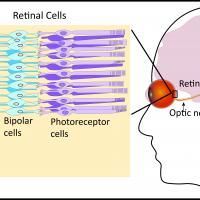
Schematic of photoreceptors and bipolar cells in the retina.

Scientists discover gene therapy provides neuroprotection to prevent glaucoma vision loss

A form of gene therapy protects optic nerve cells and preserves vision in mouse models of glaucoma, according to research supported by NIH’s National Eye Institute. The findings suggest a way forward for developing neuroprotective therapies for glaucoma.
neurons

How neurons get past "no"

When looking at a complex landscape, the eye needs to focus in on important details without losing the big picture. Now, a new study by Salk scientists shows how inhibitory neurons play a critical role in this process.z
bacteria

E.U. - U.S. NIH collaborative symposium and workshop on AMD and the microbiome

NEI and European researchers hosted international investigators on June 18, 2021, to present and discuss recent advances in age-related macular degeneration (AMD) and its relationship to the microbiome.
Brain illustration with recycling logo

NIH-funded study shows children recycle brain regions when acquiring new skills

Scientists studied the brain activity of school-aged children during development and found that regions that activated upon seeing limbs (hands, legs, etc.) subsequently activated upon seeing faces or words when the children grew older.