Skip to content

NIH Websites Are Changing

NIH is moving the launch of its new website to the fall to ensure the best possible experience for everyone who relies on our websites for health information, research, funding opportunities, and other resources.
Get the Latest Updates and FAQs

NEI Research News

Thanks to the work of NEI scientists and grantees, we’re constantly learning new information about the causes and treatment of vision disorders. Get the latest updates about their work — along with other news about NEI.

Source
455 items
Photo shows T. Michael Redmond, Ph.D.

NIH vision researcher T. Michael Redmond recognized with Champalimaud Vision Award

Vision researcher, T. Michael Redmond, Ph.D., chief of the National Eye Institute (NEI) Laboratory of Retinal Cell and Molecular Biology, is a recipient of the 2018 António Champalimaud Vision Award for foundational science discoveries about the molecular
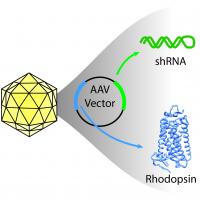
Illustration of icosahedral virus capsid, containing circular AAV vector. Arrows point from green and blue colored regions of the vector to shRNA and rhodopsin protein, respectively.

Researchers find potential new gene therapy for blinding disease

Scientists funded by the National Eye Institute (NEI) report a novel gene therapy that halts vision loss in a canine model of a blinding condition called autosomal dominant retinitis pigmentosa (adRP).
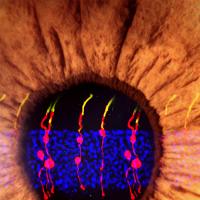
Artistic image shows Müller glia-derived rod photoreceptors.

NIH-funded researchers reverse congenital blindness in mice

Researchers funded by the National Eye Institute (NEI) have reversed congenital blindness in mice by changing supportive cells in the retina called Müller glia into rod photoreceptors.
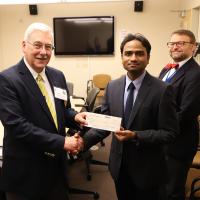
James Golladay and Aman George hold up grant award check

Knights Templar Eye Foundation awards research grant to NEI scientist

National Eye Institute (NEI) Postdoctoral Fellow Aman George, Ph.D., has received a $65,000 grant from the Knights Templar Eye Foundation to identify new drug treatments for vision impairment in children with a type of albinism.
Glaucoma causes the loss of peripheral vision. This photo shows two boys in the center surrounded by blackness to depict the tunnel vision that can occur as the disease progresses.

NEI funded researchers identify 133 genetic variants that predict glaucoma risk

Researchers funded by the National Eye Institute (NEI) have identified 133 genetic variants that predict with 75-percent accuracy a person’s risk for developing glaucoma related to elevated pressure within the eye.
Ground squirrel curled up in a nest

NIH researchers develop 'hibernation in a dish' to study how animals adapt to the cold

Researchers at the National Eye Institute have discovered cellular mechanisms that help the 13-lined ground squirrel survive hibernation.
capsules

Omega-3s from fish oil supplements no better than placebo for dry eye

Omega-3 fatty acid supplements taken orally proved no better than placebo at relieving symptoms or signs of dry eye, according to the findings of a well-controlled trial funded by the National Eye Institute (NEI), part of the National Institutes of Health

Immune cells in the retina can spontaneously regenerate

Immune cells called microglia can completely repopulate themselves in the retina after being nearly eliminated, according to a new study in mice from scientists at the National Eye Institute (NEI).
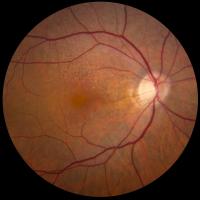
A fundus photo of a patient with reticular pseudodrusen shows a giraffe-like macular pattern.

NIH launches international study of AMD progression

A new clinical study led by the National Eye Institute (NEI), part of the National Institutes of Health, will follow 500 people over five years to learn more about the natural history of early age-related macular degeneration (AMD).
Driving simulators enable researchers to study potentially dangerous driving situations

Low vision research shifts into overdrive

Tim Goetz drives about 200,000 miles each year. Remarkably, Goetz is legally blind.