Thanks to the work of NEI scientists and grantees, we’re constantly learning new information about the causes and treatment of vision disorders. Get the latest updates about their work — along with other news about NEI.
Spider-like cells inside the brain, spinal cord and eye hunt for invaders, capturing and then devouring them. These cells, called microglia, often play a beneficial role by helping to clear trash and protect the central nervous system against infection.
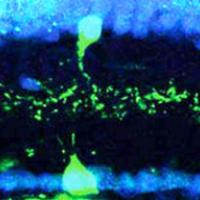
Researchers at Washington University School of Medicine in St. Louis have identified a neural circuit in the retina that enable the eye to detect movement.
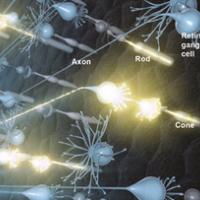
New research, published online May 7 in the journal Neuron, describes how axons of specialized nerve cells find their way through the brain’s maze of neurons to make the right connection.
Gene therapy for Leber congenital amaurosis (LCA), an inherited disorder that causes vision loss starting in childhood, improved patients’ eyesight and the sensitivity of the retina within weeks of treatment.
Five bold projects will develop new technology to noninvasively image cells of the eye in unprecedented detail.The National Eye Institute (NEI) announced the awards as part of its Audacious Goals Initiative.
The National Eye Institute (NEI) recently launched the first-ever human gene therapy trial for the vision disorder X-linked retinoschisis (XLRS). Researchers are conducting the trial at the National Institutes of Health Clinical Research Center in...
A class of medications long used to curb HIV infection shows promise as a therapy for age-related macular degeneration (AMD), suggest findings from an NIH-funded study.
New study suggests that neurons in the developing brains of mice are guided by a simple but elegant birth order rule that allows them to find and form their proper connections.
In laboratory tests, researchers have used electrical stimulation of retinal cells to produce the same patterns of activity that occur when the retina sees a moving object.