Skip to content

NEI Research News

Thanks to the work of NEI scientists and grantees, we’re constantly learning new information about the causes and treatment of vision disorders. Get the latest updates about their work — along with other news about NEI.

Source
234 items
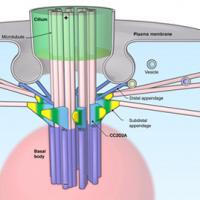
Individual cilia grow from the basal body of a cell with assistance from distal and subdistal appendages (Credit: Shobi Veleri, Ph.D., National Eye Institute)

NIH study reveals gene critical to the early development of cilia

Researchers at the National Eye Institute (NEI) have described the functions of a gene responsible for anchoring cilia — sensory hair-like extensions present on almost every cell of the body.
Grantee News

Researchers Use Human Stem Cells to Create Light-Sensitive Retina in a Dish

Using a type of human stem cell, researchers have created a three-dimensional complement of human retinal tissue in the laboratory, which notably includes functioning photoreceptor cells capable of responding to light
Grantee News

JHU Biologists Identify New Neural Pathway in Eyes that Aids in Vision

A type of retina cell plays a more critical role in vision than previously known, a team led by Johns Hopkins University researchers has discovered.
Grantee News

IU School of Optometry study: New technique detects microscopic diabetes-related eye damage

Indiana University researchers have detected new early-warning signs of the potential loss of sight associated with diabetes. This discovery could have far-reaching implications for the diagnosis and treatment of diabetic retinopathy
To learn more about AGI, please visit www.nei.nih.gov/audacious/.

NEI announces funding for new imaging technology to support Audacious Goal

The National Eye Institute has announced a funding opportunity for imaging cells and tissues of the visual system.
Grantee News

Motion-Sensing Cells in the Eye Let the Brain ‘Know’ About Directional Changes

Biologists at UC San Diego discovered that the ability of our brains to figure out and process directional movements is a result of the activation in the cortex of signals that originate from the direction-sensing cells in the retina.
Grantee News

In the eye of a chicken, a new state of matter comes into view

The unusual arrangement of cells in a chicken's eye constitutes the first known biological occurrence of a potentially new state of matter known as “disordered hyperuniformity,” according to researchers.
The retina has several layers of nerve cells. Photoreceptors (top, in green) are responsible for detecting light and converting it into electrical signals. Image courtesy of Wei Li, Ph.D., Unit on Retinal Neurophysiology, National Eye Institute.

Within sight: Light-activated drugs for restoring vision

Researchers have made progress toward an approach that would use light-sensitive drugs to stimulate cells in the retina and restore vision to people who are blind or visually impaired.
Grantee News

Light Exposure During Pregnancy Key to Normal Eye Development

Blood vessels that normally regress in mice before the eyelids open 10 days after birth persist if the mouse fetus receives insufficient light in the womb — showing that the eye needs light to develop during pregnancy.
Dr. Krzysztof Palczewski

Translational research through teamwork

Imagine you are building a house. You would need a team of specialists, including an architect, a general contractor, carpenters, an electrician, a plumber and many others.