Skip to content

NEI Research News

Thanks to the work of NEI scientists and grantees, we’re constantly learning new information about the causes and treatment of vision disorders. Get the latest updates about their work — along with other news about NEI.

Source
446 items
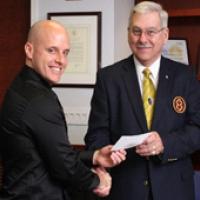
James W. Gollady, Jr., Right Eminent Department Commander (right), presents Hotaling with a check from the Knights Templar Eye Foundation. “I think this award is extremely important to pave a pathway for me in medical research,” said Hotaling.  (Joe Balintfy, NEI)

NEI Scientist Receives Research Grant from Knights Templar Eye Foundation

NEI research fellow Nathan Hotaling, PhD, has been awarded a $65,000 grant from the Knights Templar Eye Foundation to develop a stem cell-based system to study Best disease, a genetic disorder that can cause progressive vision loss.
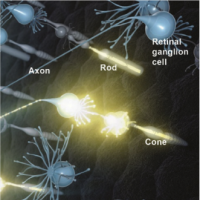
Rods and Cones image

NIH Vision Scientists Test Theory of How Rods in our Retina Originated

Retinas from our earliest vertebrate ancestors had cone-like photoreceptors, presumably allowing them to see in daylight, but little ability to see at night.
NAEC Group member photo

NEI Welcomes Four New Members to National Advisory Eye Council

Today four new members join the National Advisory Eye Council, an advisory body for the National Eye Institute (NEI) at NIH.
Dr. Emily Chew of the National Eye Institute examines a patient’s eyes. Photo credit: National Eye Institute.

Eye Study Underscores the Long-lasting Benefits of Controlling Diabetes

People with type 2 diabetes who intensively controlled their blood sugar level were found to have cut their risk of diabetic retinopathy in half.
African American male patient gets eye exam from doctor

Visual impairment, blindness cases in U.S. expected to double by 2050

The number of people with visual impairment or blindness in the United States is expected to double to more than 8 million by 2050, according to projections.
Patient undergoes and eye exam. Courtesy National Eye Institute.

Age-related macular degeneration before and after the era of anti-VEGF drugs

In a study of nearly 650 people with the eye disease age-related macular degeneration (AMD), half still had vision 20/40 or better after five years of treatment with anti-VEGF drugs that are injected into the eye.
May is Healthy Vision Month which is not just about seeing an Eye Chart

May is Healthy Vision Month

David Watson has worn glasses to correct nearsightedness the majority of his life, and had his vision checked regularly to make sure his prescription was up to date.
Robert “Bob” Nussenblatt

NEI Remembers Robert “Bob” Nussenblatt (1948-2016)

Robert Nussenblatt, M.D., chief of the Laboratory of Immunology at the National Eye Institute (NEI), died on April 17 at age 67.
Scientists are designing an accommodating contact lens for presbyopia, a condition that tends to occur in one’s forties when a stiffening of the eye’s lens makes it difficult to focus on close objects. Many of the components for the contact lens – the sensors, electronics, solar cells – would be embedded along the edge of a flexible material. Credit: Hongrui Jiang, Ph.D., University of Wisconsin, Madison.

Fish and Insects Guide Design for Future Contact Lenses

Making the most of the low light in the muddy rivers where it swims, the elephant nose fish survives by being able to spot predators amongst the muck with a uniquely shaped retina, the part of the eye that captures light.
Butler working in the cage wash area.

NEI Employment Program for People with Intellectual Disabilities Celebrates 10 Years

Andrew Butler may be one of the hardest working people at NIH. He has to be, because he works at the NIH Central Animal Facility—home to the many rodents and other laboratory animals that are a vital part of NIH research.