Skip to content

NEI Research News

Thanks to the work of NEI scientists and grantees, we’re constantly learning new information about the causes and treatment of vision disorders. Get the latest updates about their work — along with other news about NEI.

Source
467 items
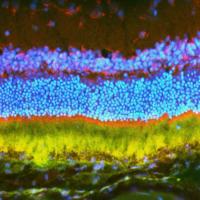
Multicolor image of retina in cross-section

Scientists Use Nanoparticle-Delivered Gene Therapy to Inhibit Blinding Eye Disease in Rodents

In experiments in rats and mice, two Johns Hopkins scientists report the successful use of nanoparticles to deliver gene therapy for blinding eye disease.
A person cuts up a bell pepper.

Scientists Discover a New Connection Between the Eyes and Touch

Tiny eye movements can be used as an index of humans’ ability to anticipate relevant information in the environment independent of the information’s sensory modality.
Brad Gelfand, Ph.D., in the laboratory

Exercise Can Slow or Prevent Vision Loss, Study Finds

Exercise can slow or prevent the development of macular degeneration and may benefit other common causes of vision loss, such as glaucoma and diabetic retinopathy, new research from the University of Virginia suggests.
Photo with only the center visible

UB-UAB collaboration stimulates rethinking of a degenerative eye disease

Researchers from the University of Buffalo have found new information about retinitis pigmentosa, a condition that begins in childhood with night blindness and loss of peripheral vision.
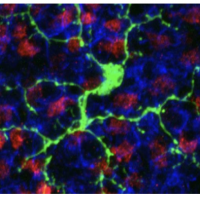
Fluorescent green cell with long projections

Star-Shaped Brain Cells May Play a Critical Role in Glaucoma

After a brain injury, cells that normally nourish nerves may actually kill them instead, a new NYU study in rodents finds. This “reactive” phenomenon may be the driving factor behind neurodegenerative diseases like glaucoma, a leading cause of blindness.
Layers of the retina as drawn by Ramon y Cajal

Researchers look to the eye for insights about the brain

Researchers seeking to unravel the mysteries of how our amazingly complex brains do what they do, often start with the eye. The retina, the light-sensing tissue at the back of the eye has long been a model for scientists to explore how the brain works.
An illustration of a human brain with stimulated neurons.

Inhibitory Interneurons in Hippocampus Excite the Developing Brain

A new study from the George Washington University finds that in some parts of the developing brain, the inhibitory neurons cause excitation rather than suppression of brain activity, which could have implications for the treatment of neonatal seizures.
Microscopy image of lens and zone fibers stained red, blue and green.

New research on Marfan syndrome focuses on eyes

New NEI-supported research provides insight into the eye conditions associated with Marfan syndrome, where weakened zonule fibers cause vision problems.
Image of fluorescent cells in iris-like pattern

IU researchers model human stem cells to identify degeneration in glaucoma

Using human stem cell models, researchers at Indiana University School of Medicine found they could analyze deficits within cells damaged by glaucoma, with the potential to use this information to develop new strategies to slow the disease process.
Man getting his eyes examined by a doctor using a slit lamp

Retinitis pigmentosa research probes role of the enzyme DHDDS in this genetic disease

Researchers who made a knock-in mouse-model of the genetic disorder retinitis pigmentosa 59, or RP59, found no retinal degeneration or thinning, calling into question the commonly accepted mechanism for RP59.