Skip to content

NEI Research News

Thanks to the work of NEI scientists and grantees, we’re constantly learning new information about the causes and treatment of vision disorders. Get the latest updates about their work — along with other news about NEI.

Source
446 items
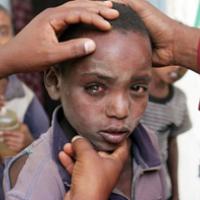
Children who slept near a cooking fire were four times as likely to develop severe trachoma compared with children who slept in ventilated rooms without cooking fires. This child’s severe trachoma led to loss of vision in his left eye. Photo courtesy of Raul Vasquez/Orbis.

Trachoma Risk Tied to Sleeping Near Cooking Fires, Lack of Ventilation

Children who sleep in unventilated rooms with cooking fires are at greater risk for severe trachoma, a leading cause of preventable blindness in developing countries.
A microglial cell (green) extends spider-like arms to capture and consume rod photoreceptor cells (blue). Credit: Dr. Wai Wong, NEI.

In Blinding Eye Disease, Trash-Collecting Cells go Awry, Accelerate Damage

Spider-like cells inside the brain, spinal cord and eye hunt for invaders, capturing and then devouring them. These cells, called microglia, often play a beneficial role by helping to clear trash and protect the central nervous system against infection.
still from DR eye exam animation

Study Finds Potential New Drug Target for Diabetic Eye Disease

Researchers funded in part by the National Eye Institute (NEI) have identified a protein involved in an advanced stage of diabetic retinopathy, a diabetic eye disease that threatens vision.
Ebola virus, isolated in November 2014 from patient blood samples obtained in Mali. The virus was isolated on Vero cells in a BSL-4 suite at NIAID Rocky Mountain Laboratories. Credit: NIAID

Study of Ebola Survivors Opens in Liberia

The Liberia-U.S. clinical research partnership known as PREVAIL has launched a study of people in Liberia who have survived Ebola virus disease (EVD) within the past two years.
A pronghorn antelope in the Grand Teton National Park captured by a DSLR camera using the image stabilization function (left). The image on the right was artificially blurred to simulate one’s vision without the work of direction-sensitive ganglion cells. Photo is courtesy of Lu O. Sun, Johns Hopkins Medicine.

The Brain’s Autofocus System Helps Stabilize Vision Despite Motion

Much like the automatic focus of a camera, our eyes and brains must constantly recalibrate so that we can get a clear view of the changing—and always moving—world around us.
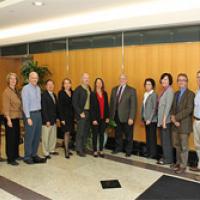
Leaders from the University of Philippines (UP) and Philippine NIH (PNIH) met with NEI staff in May 2015. From L to R: Dr. Fielding Hejtmancik; Dr. Marie Carmela M. Lapitan, director of research management and translation, PNIH; Dr. Arlene Samaniego, vice chancellor, UP; Dr. Eva Maria Cutiongco-de la Paz, vice chancellor for research and executive director, PNIH; Dr. Belinda Seto; Dr. Carmencita Padilla; Dr. Paul A. Sieving; Dr. Gyan Prakash, Dr. Patricia Cabrera; and Dr. Manuel Datiles.

Dr. Patricia Cabrera: Learning Genetics and Linking NEI to the Philippines

A delegation from the University of the Philippines (UP) and the Philippine National Institutes of Health recently visited NEI on May 21, 2015. It was an opportunity to renew old collaborations and discuss new ones...
From left, Johnson-Thompson, Legge, and Massof after presentation of Helen Keller Prize for Vision Research. Photo courtesy of Dustin Hays.

Two NEI Grantees Awarded Helen Keller Prize

Two researchers funded by the National Eye Institute (NEI), both pioneers in the study of low vision, received the Helen Keller Prize for Vision Research on May 5, in Denver.
LCA is an inherited disorder that causes vision loss in childhood. It primarily affects the functioning of the retina, the light-sensitive tissue at the back of the eye, as shown here. Photo credit: National Eye Institute

NIH-funded Study Points Way Forward for Retinal Disease Gene Therapy

Gene therapy for Leber congenital amaurosis (LCA), an inherited disorder that causes vision loss starting in childhood, improved patients’ eyesight and the sensitivity of the retina within weeks of treatment.
Artist's rendering of neural activity in the retina. Light that enters the eye activates rod and cone photoreceptors, which in turn activate retinal ganglion cells. Signals travel to the brain via retinal ganglion cell axons. Photo credit: National Eye Institute.

NIH Launches Research to Gaze Deeply Into Your Eyes

Five bold projects will develop new technology to noninvasively image cells of the eye in unprecedented detail.The National Eye Institute (NEI) announced the awards as part of its Audacious Goals Initiative.
Eye Examination

Early Tight Blood Glucose Control Reduces Eye Surgeries in People with Type 1 Diabetes

People with type 1 diabetes who intensively control their blood glucose (blood sugar) early in their disease, versus those who do not, are 48 percent less likely to need eye surgery, and the total number of such surgeries is 37 percent less.