
Skip to content

NEI Research News

Thanks to the work of NEI scientists and grantees, we’re constantly learning new information about the causes and treatment of vision disorders. Get the latest updates about their work — along with other news about NEI.

Source
472 items
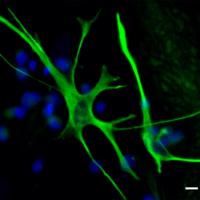
Layers of the retina as drawn by Ramon y Cajal

Researchers look to the eye for insights about the brain

Researchers seeking to unravel the mysteries of how our amazingly complex brains do what they do, often start with the eye. The retina, the light-sensing tissue at the back of the eye has long been a model for scientists to explore how the brain works.
An illustration of a human brain with stimulated neurons.

Inhibitory Interneurons in Hippocampus Excite the Developing Brain

A new study from the George Washington University finds that in some parts of the developing brain, the inhibitory neurons cause excitation rather than suppression of brain activity, which could have implications for the treatment of neonatal seizures.
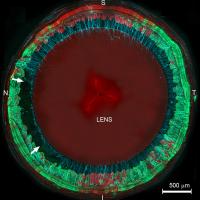
Microscopy image of lens and zone fibers stained red, blue and green.

New research on Marfan syndrome focuses on eyes

New NEI-supported research provides insight into the eye conditions associated with Marfan syndrome, where weakened zonule fibers cause vision problems.
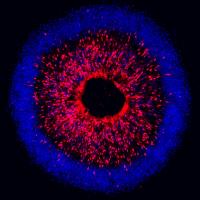
Image of fluorescent cells in iris-like pattern

IU researchers model human stem cells to identify degeneration in glaucoma

Using human stem cell models, researchers at Indiana University School of Medicine found they could analyze deficits within cells damaged by glaucoma, with the potential to use this information to develop new strategies to slow the disease process.
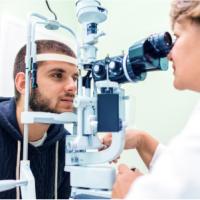
Man getting his eyes examined by a doctor using a slit lamp

Retinitis pigmentosa research probes role of the enzyme DHDDS in this genetic disease

Researchers who made a knock-in mouse-model of the genetic disorder retinitis pigmentosa 59, or RP59, found no retinal degeneration or thinning, calling into question the commonly accepted mechanism for RP59.
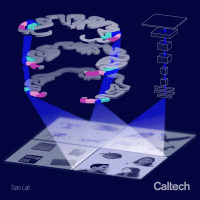
Slices of brain with specific regions highlighted, suspended over images of faces

Faces, bodies, spiders, and radios: How the brain represents visual objects

Caltech researchers have combined tools from machine learning and neuroscience to discover that the brain uses a mathematical system to organize visual objects according to their principal components. The work was published June 3 in Nature.
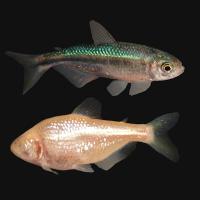
Surface-dwelling fish with an eye, and pale cave fish without eye

Gene Found that Causes Eyes to Wither in Cavefish

University of Maryland-led study identified the first gene responsible for eye loss in cavefish, revealing connection to a human vascular disease.
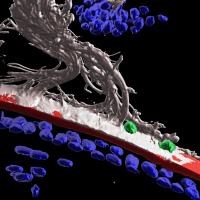
3D reconstruction showing cells along fibrils

Eye Injury Sets Immune Cells On Surveillance To Protect The Lens

Researchers at Thomas Jefferson University finds that the eye launches an immune response in the lens after injury. After injury to the cornea, immune cells travel from the ciliary body to the lens along fibers known as ciliary zonules.

Early visual experience drives precise alignment of cortical networks critical for binocular vision

Researchers at the Max Planck Florida Institute for Neuroscience identify three distinct cortical representations that develop independent of visual experience but undergo experience-dependent reshaping, an essential part of cortical network maturation.
Fluorescent images of mouse retinal layers

Retinal Texture Could Provide Early Biomarker Of Alzheimer’s Disease

Biomedical engineers at Duke University have devised a new imaging device capable of measuring the various layers of the retina at the back of the eye, which could be used to detect Alzheimer's disease.