Skip to content

NEI Research News

Thanks to the work of NEI scientists and grantees, we’re constantly learning new information about the causes and treatment of vision disorders. Get the latest updates about their work — along with other news about NEI.

Source
450 items
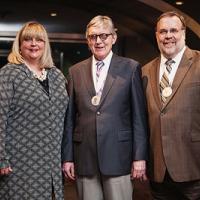
From left, Johnson-Thompson, Legge, and Massof after presentation of Helen Keller Prize for Vision Research. Photo courtesy of Dustin Hays.

Two NEI Grantees Awarded Helen Keller Prize

Two researchers funded by the National Eye Institute (NEI), both pioneers in the study of low vision, received the Helen Keller Prize for Vision Research on May 5, in Denver.
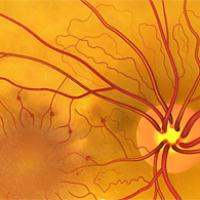
LCA is an inherited disorder that causes vision loss in childhood. It primarily affects the functioning of the retina, the light-sensitive tissue at the back of the eye, as shown here. Photo credit: National Eye Institute

NIH-funded Study Points Way Forward for Retinal Disease Gene Therapy

Gene therapy for Leber congenital amaurosis (LCA), an inherited disorder that causes vision loss starting in childhood, improved patients’ eyesight and the sensitivity of the retina within weeks of treatment.
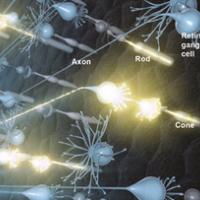
Artist's rendering of neural activity in the retina. Light that enters the eye activates rod and cone photoreceptors, which in turn activate retinal ganglion cells. Signals travel to the brain via retinal ganglion cell axons. Photo credit: National Eye Institute.

NIH Launches Research to Gaze Deeply Into Your Eyes

Five bold projects will develop new technology to noninvasively image cells of the eye in unprecedented detail.The National Eye Institute (NEI) announced the awards as part of its Audacious Goals Initiative.
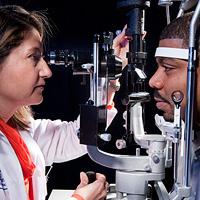
Eye Examination

Early Tight Blood Glucose Control Reduces Eye Surgeries in People with Type 1 Diabetes

People with type 1 diabetes who intensively control their blood glucose (blood sugar) early in their disease, versus those who do not, are 48 percent less likely to need eye surgery, and the total number of such surgeries is 37 percent less.
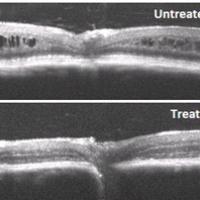
Cross-sectional images of retina from retinoschisin-deficient mice, untreated and treated with XLRS gene therapy.

NEI Human Gene Therapy Trial for Retinoschisis Underway

The National Eye Institute (NEI) recently launched the first-ever human gene therapy trial for the vision disorder X-linked retinoschisis (XLRS). Researchers are conducting the trial at the National Institutes of Health Clinical Research Center in...
Illustration showing the retina as seen through a dilated pupil.

Eylea outperforms other drugs for diabetic macular edema with moderate or worse vision loss

In an NIH-supported clinical trial comparing three drugs for diabetic macular edema (DME), Eylea (aflibercept) provided greater visual improvement, on average, than did Avastin (bevacizumab) or Lucentis (ranibizumab) when vision was 20/50 or worse.
 If a study participant were instructed to pay attention to “scenes” and he was attending well, he would be shown the top image as a reward. As his attention lapsed, the middle and bottom images would be shown. The face in the photograph is that of the study’s first author, Megan deBettencourt, a doctoral candidate at the Princeton Neuroscience Institute.

Brain Training May Bolster Visual Attention

People are bad at staying focused. We’ve all had our minds wander when we try to concentrate on a task that requires paying close attention but isn’t all that engaging.
Degenerated RPE cells from mice with geographic atrophy are shown at left. Treating the mice with NRTIs protected the RPE cells. Photos courtesy of Jayakrishna Ambati, M.D.

HIV drugs show promise for “dry” AMD

A class of medications long used to curb HIV infection shows promise as a therapy for age-related macular degeneration (AMD), suggest findings from an NIH-funded study.
Clinical study of a new eye drop may offer hope to patients with dry eye. Photo courtesy of Patrick Walderzak.

NEI sets stage for new clinical trial to tackle dry eye

For some people it feels like a speck of sand in the eye, or stinging or burning that doesn’t go away. For others, dry eye disease (or simply dry eye) can become a chronic condition that leads to blurred vision or even vision loss if it goes untreated.
Retinal pigment epithelium derived from induced pluripotent stem cells. Photo credit: Dr. Kapil Bharti.

Gene profiling technique to accelerate stem cell therapies for eye diseases

Researchers at the National Institutes of Health have developed a technique that will speed up the production of stem-cell derived tissues.