Skip to content

NEI Research News

Thanks to the work of NEI scientists and grantees, we’re constantly learning new information about the causes and treatment of vision disorders. Get the latest updates about their work — along with other news about NEI.

Source
467 items
Grantee News

Retinal cells go with the flow to assess own motion through space

A new NEI-funded study in Nature helps to explain how specialized retinal cells help stabilize vision by perceiving how their owner is moving.
Grantee News

Brain "rewires" itself to enhance other senses in blind people

Researchers have found that the brain makes new connections in those with early blindness (i.e. those born with or who have acquired profound blindness before the age of 3).
Grantee News

A Better View of How Tumors Form in the Eye

The formation of tumors in the eye can cause blindness. But, for some reason our corneas, the transparent layer that forms the front of our eyes, have a natural ability to prevent it.
Fly head

New light sensing molecule discovered in the fruit fly brain

Six biological pigments called rhodopsins play well-established roles in light-sensing in the fruit fly eye. Three of them also have light-independent roles in temperature sensation.
Grantee News

Preschool Children Face Increasing Vision Problems Over Coming Decades According to USC Roski Eye Institute Research Article in JAMA Ophthalmology

NEI funded research experts at the University of Southern California Roski Eye Institute found that visual impairment in preschool children will increase 26 percent affecting almost 220,000 children over the next 45 years.
blueprint eye

NIH launches competition to develop human eye tissue in a dish

The National Eye Institute (NEI), part of the National Institutes of Health, has opened the first stage of a federal prize competition designed to generate miniature, lab-grown human retinas.
Corneal section from a person with Fuchs dystrophy shows the presence of ATP1B1 in the corneal endothelium.

NIH-funded team identifies genetic underpinnings of Fuchs dystrophy

An international study of more than 5,417 people helps pinpoint the genetic risk factors associated with Fuchs endothelial corneal dystrophy, the most common disorder requiring corneal transplantation.

NIH-Funded Scientists Home in on Molecular Causes of Secondary Cataract

Four to 12 percent of people undergoing cataract surgery to replace a cloudy lens with a clear artificial one develop posterior capsule opacification (PCO).
Image of a mouse retina

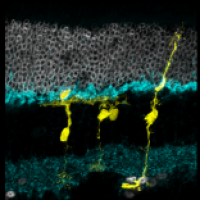
NIH scientists deploy CRISPR to preserve photoreceptors in mice

Silencing a gene called Nrl in mice prevents the loss of cells from degenerative diseases of the retina, according to a new study. The findings could lead to novel therapies for preventing vision loss from human diseases such as retinitis pigmentosa.
Xu Wang with Wai Wong in lab

Breast cancer drug dampens immune response, protecting light-sensing cells of the eye

The breast cancer drug tamoxifen appears to protect light-sensitive cells in the eye from degeneration, according to a new study in mice.