Skip to content

NEI Research News

Thanks to the work of NEI scientists and grantees, we’re constantly learning new information about the causes and treatment of vision disorders. Get the latest updates about their work — along with other news about NEI.

Source
467 items
still from DR eye exam animation

Study Finds Potential New Drug Target for Diabetic Eye Disease

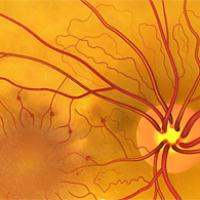
Researchers funded in part by the National Eye Institute (NEI) have identified a protein involved in an advanced stage of diabetic retinopathy, a diabetic eye disease that threatens vision.
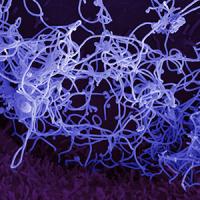
Ebola virus, isolated in November 2014 from patient blood samples obtained in Mali. The virus was isolated on Vero cells in a BSL-4 suite at NIAID Rocky Mountain Laboratories. Credit: NIAID

Study of Ebola Survivors Opens in Liberia

The Liberia-U.S. clinical research partnership known as PREVAIL has launched a study of people in Liberia who have survived Ebola virus disease (EVD) within the past two years.
Grantee News

Eye’s motion detection sensors identified

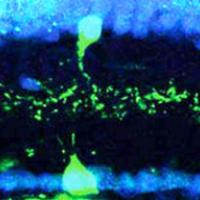
Researchers at Washington University School of Medicine in St. Louis have identified a neural circuit in the retina that enable the eye to detect movement.
Grantee News

A World Without Color – Researchers Find Gene Mutation That Strips Color, Reduces Vision

Researchers have identified a previously unknown gene mutation that underlies achromatopsia, an inherited eye disorder.
A pronghorn antelope in the Grand Teton National Park captured by a DSLR camera using the image stabilization function (left). The image on the right was artificially blurred to simulate one’s vision without the work of direction-sensitive ganglion cells. Photo is courtesy of Lu O. Sun, Johns Hopkins Medicine.

The Brain’s Autofocus System Helps Stabilize Vision Despite Motion

Much like the automatic focus of a camera, our eyes and brains must constantly recalibrate so that we can get a clear view of the changing—and always moving—world around us.
Grantee News

Plugging In Your Vision's Autostabilization Feature

New research, published online May 7 in the journal Neuron, describes how axons of specialized nerve cells find their way through the brain’s maze of neurons to make the right connection.
Grantee News

3D structure solved for vulnerable region of glaucoma-causing protein

Scientists at Georgia Tech have determined the three-dimensional structure of a key part of a protein that is associated with glaucoma and identified regions of this domain that correlate with severe forms of the disease.
Grantee News

LSU Health New Orleans Makes Discovery Key to Preventing Blindness and Stroke Devastation

Researchers at the Louisiana State University Neuroscience Center of Excellence have discovered gene interactions that determine whether cells live or die in such conditions as age-related macular degeneration and ischemic stroke.
Grantee News

Results challenge conventional wisdom about where the brain begins processing visual information

Using high-resolution functional magnetic resonance imaging (fMRI), a team of researchers from Vanderbilt and Boston universities, have discovered that more complex processing occurs in the initial stages of the visual system than previously thought.
Grantee News

​Stem Cells from Wisdom Teeth Can Be Transformed into Corneal Cells

Stem cells from the dental pulp of wisdom teeth can be coaxed to turn into cells of the eye’s cornea and could one day be used to repair corneal scarring due to infection or injury.