Thanks to the work of NEI scientists and grantees, we’re constantly learning new information about the causes and treatment of vision disorders. Get the latest updates about their work — along with other news about NEI.
The NEI has funded development of a handheld pediatric vision scanner that easily and accurately screens for amblyopia, or “lazy eye.” The device could facilitate earlier identification of children who need vision-saving treatment.
A person who has a stroke that causes vision loss is often told there is nothing they can do to improve or regain the vision they have lost. But research from the University of Rochester may offer hope to stroke patients in regaining vision.
Researchers at Thomas Jefferson University finds that the eye launches an immune response in the lens after injury. After injury to the cornea, immune cells travel from the ciliary body to the lens along fibers known as ciliary zonules.
Researchers at the Max Planck Florida Institute for Neuroscience identify three distinct cortical representations that develop independent of visual experience but undergo experience-dependent reshaping, an essential part of cortical network maturation.
Progression along an age-related macular degeneration (AMD) severity scale over two years predicts the likelihood of developing late-stage disease five years later.
Biomedical engineers at Duke University have devised a new imaging device capable of measuring the various layers of the retina at the back of the eye, which could be used to detect Alzheimer's disease.
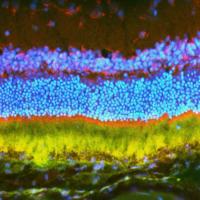
In a novel approach to gene therapy, scientists funded by the National Eye Institute (NEI) report using gold nanoparticles and light to target specific cells in mouse retina.
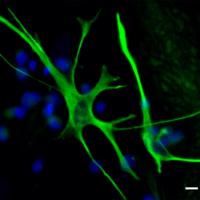
New research, led by Northwestern University, has found that a subset of retinal neurons sends inhibitory signals to the brain. Before, researchers believed the eye only sends excitatory signals.
New research by scientists at the Lewis Katz School of Medicine Temple University (LKSOM) shows that gains in functional recovery from optic nerve injuries may be possible, thanks to a molecule known as Lin28, which regulates cell growth.