Skip to content

NIH Websites Are Changing

Beginning in late July, NIH will start introducing a new website experience designed to make it easier to find health information, research, funding opportunities, and other resources. During the transition, you may notice changes to navigation, page layouts, and where some information is located. Learn more in our Frequently Asked Questions.

NEI Research News

Thanks to the work of NEI scientists and grantees, we’re constantly learning new information about the causes and treatment of vision disorders. Get the latest updates about their work — along with other news about NEI.

Source
155 items

Life after death for the human eye

Scientists have revived light-sensing neuron cells in organ donor eyes and restored communication between them as part of a series of discoveries that stand to transform brain and vision research.

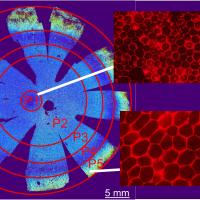
Retinal cell map could advance precise therapies for blinding diseases

Researchers have identified distinct differences among the cells comprising a tissue in the retina that is vital to human visual perception. The scientists from the National Eye Institute (NEI) discovered five subpopulations of retinal pigment epithelium.
Photoreceptor degeneration tied to lipofuscin accumulation.

Advancing a treatment for a common eye disease that lacks one

The road from discovering a potential drug to getting the therapy into the hands of patients is a long and uncertain one. An NIH program called Blueprint Neurotherapeutics Network helps basic researchers prep for clinical trials and regulatory approval.
Green retinal ganglion cell spreads dendrites in all directions.

Antabuse may help revive vision in people with progressive blinding disorders

Researchers at the University of California, Berkeley, have found that a drug once widely used to wean alcoholics off of drinking helps to improve sight in mice with retinal degeneration.
Artist's rendering of photoreceptor signaling a retinal ganglion cell

Implanted chip, natural eyesight coordinate vision in study of macular degeneration patients

A Stanford scientist and his colleagues show that patients fitted with a chip in their eye are able to integrate what the chip “sees” with objects their natural peripheral vision detects.
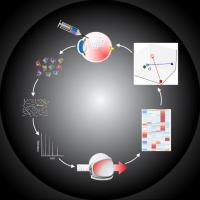
Schematic summarizing the research by Sodhi’s team.

Study Finds Up to 30% of Patients with Wet Macular Degeneration Can Safely Stop Eye Injections

In a preliminary study, Johns Hopkins Medicine researchers report that as many as a third of those with "wet" age-related macular degeneration may someday be able to safely stop eye injection therapy without further vision loss.
Man with patch over his eye.

Cataract surgery does not cause disease progression in people with AMD

People with age-related macular degeneration (AMD) can undergo cataract surgery without fear of worsening their disease.

NIH researchers identify potential AMD drugs with stem-cell based research tool

Using a stem-cell-derived model, researchers have identified two drug candidates that may slow dry age-related macular degeneration (AMD), a leading cause of blindness for which no treatment exists.
View of grocery store aisle from AMD perspective

Link found between lupus, macular degeneration

School of Medicine researchers have made a discovery linking lupus, a potentially debilitating autoimmune disorder, and macular degeneration, a leading cause of blindness.
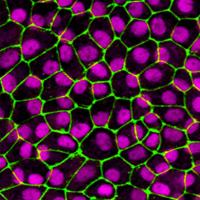
Retinal pigment epithelial cells stained green and magenta

CU Researchers Provide First Evidence Linking Extracellular Vesicles with Drusen Formation and Age-Related Macular Degeneration

CellSight researchers at the University of Colorado School of Medicine are offering the first evidence connecting drusen formation, or yellowish deposits that accumulate under the retina, with extracellular vesicles and age-related macular degeneration.