Thanks to the work of NEI scientists and grantees, we’re constantly learning new information about the causes and treatment of vision disorders. Get the latest updates about their work — along with other news about NEI.
Scientists have discovered a mechanism by which an area of a protein shape-shifts to convert vitamin A into a usable form for the eye’s light-sensing photoreceptor cells.
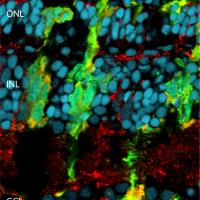
A basic research study from the National Eye Institute (NEI) explains how the molecule transducin moves within light-sensing rod photoreceptors in mouse retina to help the eye quickly adapt from bright to low light and back.
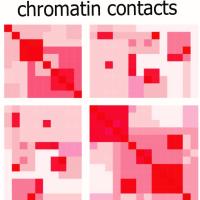
National Eye Institute researchers mapped the organization of human retinal cell chromatin, the fibers that package 3 billion nucleotide-long DNA molecules into compact structures that fit into chromosomes within each cell’s nucleus.
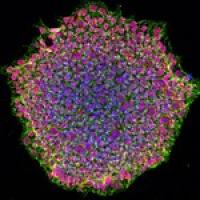
The protocol gives step-by-step instructions, starting with patient-derived pluripotent stem cells, transitioning them to retinal pigment epithelium (RPE) cells and finally maturing them into RPE tissue.
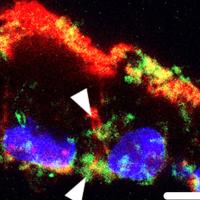
Researchers from the National Eye Institute (NEI) have developed a gene therapy that rescues cilia defects in retinal cells affected by a type of Leber congenital amaurosis (LCA), a disease that causes blindness in early childhood.
Three scientific teams that developed physiologically competent retinal organoid systems have won the final phase of the 3D Retinal Organoid Challenge (3D ROC).
A multi-institutional effort led by researchers at the UPenn School of Veterinary Medicine is taking steps to develop an effective technique to regenerate photoreceptors cells and restore sight in people with vision disorders.
Using a new imaging technique, researchers from the National Eye Institute have determined that retinal lesions from vitelliform macular dystrophy (VMD) vary by gene mutation.
Loss of the protein pigment epithelium-derived factor (PEDF), which protects retinal support cells, may drive age-related changes in the retina, according to a new study in mice from the National Eye Institute.
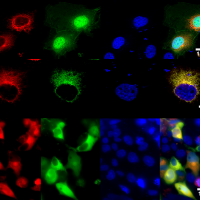
Scientists at LSU Health New Orleans Neuroscience Center of Excellence have developed a new, experimental human cell line from retinal pigment epithelial cells.