Skip to content

NIH Websites Are Changing

NIH is moving the launch of its new website to the fall to ensure the best possible experience for everyone who relies on our websites for health information, research, funding opportunities, and other resources.
Get the Latest Updates and FAQs

NEI Research News

Thanks to the work of NEI scientists and grantees, we’re constantly learning new information about the causes and treatment of vision disorders. Get the latest updates about their work — along with other news about NEI.

Source
474 items
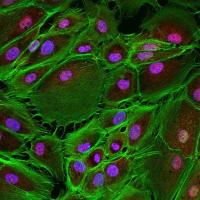
Human iPSC-derived retinal pigment epithelium (RPE).

UC Irvine study shows similarities and differences in human and insect vision formation

Researchers have discovered profound similarities and surprising differences between humans and insects in the production of the critical light-absorbing molecule of the retina, 11-cis-retinal, also known as the “visual chromophore.”
Glaucoma and the optic nerve

Researchers identify genes and cell types that may have causal role in primary open-angle glaucoma formation

In a new study, researchers conducted a comprehensive study that uncovered key genes, biological processes and cell types that may affect the pathogenesis of primary open angle glaucoma, in intraocular pressure-dependent and independent manners.

Retinal photoreceptors use dual pathways to tell brain ‘I’ve seen the light!’

Neuroscientists at Johns Hopkins Medicine have shown that intrinsically-photosensitive retinal ganglion cells use two different pathways at the same time to transmit electrical “vision” signals to the brain.

Knowing what dogs like to watch could help veterinarians assess their vision

University of Wisconsin-Madison study to support development of more sensitive ways to assess canine vision discovers what dogs most like to watch.
Pipet

New technique enhances quality control of lab-grown cells for AMD treatment

NEI researchers improved a crucial step in the production of retinal pigment epithelium (RPE), a tissue they grow in the lab from patient blood cells and are testing in a clinical trial as treatment for AMD.
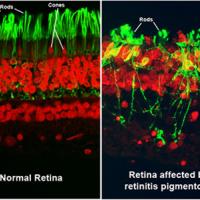
The image on the left is labeled "Normal retina," and shows green rods and red cones. The image on the right is labeled "Retina affected by retinitis pigmentosa," and shows green rods that have broken down.

Researchers engineer in vivo delivery system for prime editing, partially restoring vision in mice

By adapting virus-like particles to carry the machinery for a type of gene editing called prime editing, scientists have corrected disease-causing mutations in animals and increased editing efficiency.
Office-Glaucoma

New research aims to develop novel therapeutic for glaucoma

Researchers at Indiana University School of Medicine are using a novel approach to hopefully develop a new therapy for glaucoma, a complex disease that eventually leads to blindness.
Close up of woman's face.

UH Optometry researcher receives $1.4 million to map the cornea

A team of scientists have received funding to explore new approaches to disentangle intricate nerve networks in the cornea and discover which nerve makes people blink, which creates tears and which nerve tells us our eye is in pain.

U.S. - Ireland R&D Partnership hosts workshop

About 50 participants took part in the virtual event, designed to raise awareness of the U.S.- Ireland R&D Partnership Program.

Study identifies "visual system" protein for circadian rhythm stability

Scientists have identified a protein in the visual system of mice that appears to be key for stabilizing the body’s circadian rhythms by buffering the brain’s response to light.