Thanks to the work of NEI scientists and grantees, we’re constantly learning new information about the causes and treatment of vision disorders. Get the latest updates about their work — along with other news about NEI.
A study in mice funded by the National Institutes of Health (NIH) shows for the first time that high-contrast visual stimulation can help damaged retinal neurons regrow optic nerve fibers, otherwise known as retinal ganglion cell axons.
NEI research fellow Nathan Hotaling, PhD, has been awarded a $65,000 grant from the Knights Templar Eye Foundation to develop a stem cell-based system to study Best disease, a genetic disorder that can cause progressive vision loss.
A pain medicine that potently activates a receptor vital to a healthy retina appears to help preserve vision in an animal model of severe retinal degeneration, NEI-funded scientists at Medical College of Georgia at Augusta University report.
Retinas from our earliest vertebrate ancestors had cone-like photoreceptors, presumably allowing them to see in daylight, but little ability to see at night.
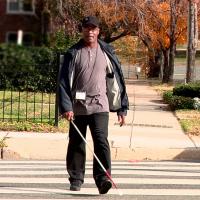
The number of people with visual impairment or blindness in the United States is expected to double to more than 8 million by 2050, according to projections.
The University of Southern California (USC) Roski Eye Institute researchers and clinicians published results of the largest population-based study of adult Latinos and age-related macular degeneration (AMD).
In a study of nearly 650 people with the eye disease age-related macular degeneration (AMD), half still had vision 20/40 or better after five years of treatment with anti-VEGF drugs that are injected into the eye.
David Watson has worn glasses to correct nearsightedness the majority of his life, and had his vision checked regularly to make sure his prescription was up to date.