Because of a lapse in government funding, the information on this website may not be up to date, transactions submitted via the website may not be processed, and the agency may not be able to respond to inquiries until appropriations are enacted. The NIH Clinical Center (the research hospital of NIH) is open. For more details about its operating status, please visit cc.nih.gov. Updates regarding government operating status and resumption of normal operations can be found at OPM.gov.
Thanks to the work of NEI scientists and grantees, we’re constantly learning new information about the causes and treatment of vision disorders. Get the latest updates about their work — along with other news about NEI.
People are bad at staying focused. We’ve all had our minds wander when we try to concentrate on a task that requires paying close attention but isn’t all that engaging.
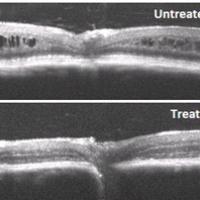
A class of medications long used to curb HIV infection shows promise as a therapy for age-related macular degeneration (AMD), suggest findings from an NIH-funded study.
Newly published research provides the first demonstration of how a genetic mutation associated with a common form of albinism leads to the lack of melanin pigments that characterizes the condition.
A new study finds that in learning a visual task, older people exhibited a surprising degree of plasticity, but had trouble filtering out irrelevant information.
For some people it feels like a speck of sand in the eye, or stinging or burning that doesn’t go away. For others, dry eye disease (or simply dry eye) can become a chronic condition that leads to blurred vision or even vision loss if it goes untreated.
In a unique study of human ocular cells, a multi-institution research team finds that glaucoma appears to be a consequence of mechanical dysfunction of a thin layer of cells that is the final barrier to fluid entering Schlemm's canal.
Research at Washington University School of Medicine in St. Louis may have implications for treating diseases involving abnormal blood vessel growth, such as the impaired wound healing often seen in diabetes.
New study suggests that neurons in the developing brains of mice are guided by a simple but elegant birth order rule that allows them to find and form their proper connections.