Skip to content

NEI Research News

Thanks to the work of NEI scientists and grantees, we’re constantly learning new information about the causes and treatment of vision disorders. Get the latest updates about their work — along with other news about NEI.

Source
942 items
LCA is an inherited disorder that causes vision loss in childhood. It primarily affects the functioning of the retina, the light-sensitive tissue at the back of the eye, as shown here. Photo credit: National Eye Institute

Participants of pioneering CRISPR gene editing trial see vision improve

About 79% of clinical trial participants experienced measurable improvement after receiving experimental, CRISPR-based gene editing that is designed to fix a rare form of blindness.
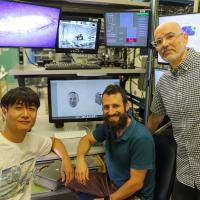
Qiuhua Yang, Yuqing Huo and Yongeng Cai in a laboratory.

MCG scientists identify new treatment target for leading cause of blindness

A gene previously implicated in the development of atherosclerotic lesions in coronary arteries could be key to understanding why many people don’t benefit from the most used therapy for neovascular age-related macular degeneration (AMD).

New fellowship program aims to further understanding of the publication process

The National Eye Institute has worked with the editors-in-chief of 7 leading vision journals to create a new two-year program: the Council of Vision Editors Fellowship Program.

Are these newly found rare cells a missing link in color perception?

Researchers used an imaging technology called adaptive optics to identify rare cells that could help fill in the gaps in existing theories of color perception.
 empty

AI makes retinal imaging 100 times faster, compared to manual method

Researchers at the National Institutes of Health applied artificial intelligence (AI) to a technique that produces high-resolution images of cells in the eye. They report that with AI, imaging is 100 times faster and improves image contrast 3.5-fold.

Medical College of Georgia scientists establish protein database to advance vision research

Aqueous Humor Proteome Database includes comprehensive information on 1,683 proteins identified in aqueous humor--the fluid in the eye's anterior chamber.
Optic nerve

Seeing a path to nerve regeneration

UConn scientists find protein that stimulates regrowth of optic nerve cells.
mosquito

Wayne State University researchers uncover potential treatment targets for Zika virus-related eye abnormalities

A groundbreaking study from Wayne State presents crucial insights into the ocular effects of Zika virus infection during pregnancy and offers promising avenues for therapeutic intervention.

NEI study points to ‘ground zero’ for AMD development

National Eye Institute researchers studying human retinas discovered 87 target genes where a mix of environmental factors likely influence one’s risk of developing age-related macular degeneration (AMD), a leading cause of vision loss.
People looking at the sky with eclipse glasses

How to watch an eclipse, safely

Keep your eyes safe when viewing the upcoming eclipse with these tips from the National Eye Institute.