Thanks to the work of NEI scientists and grantees, we’re constantly learning new information about the causes and treatment of vision disorders. Get the latest updates about their work — along with other news about NEI.
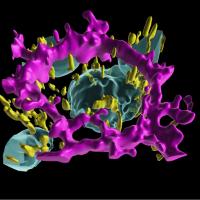
National Eye Institute (NEI) researchers have developed a digital replica of crucial eye cells, providing a new tool for studying how the cells organize themselves when they are healthy and affected by diseases.
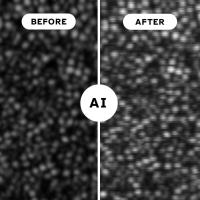
Getting the most advanced ophthalmic imaging technologies into the hands of healthcare providers will vastly improve the ability to detect retinal diseases earlier, and guide treatments to prevent vision loss.
Ten teams are being recognized for their proof-of-concept ideas following Phase 1 of the Data Sharing Index (“S-Index”) Challenge, an NIH competition aimed at incentivizing data sharing
Research funded by the National Eye Institute has identified the signaling mechanism that triggers steroid-induced glaucoma by creating a 3D “eye-on-a-chip” platform that mimics the flow of ocular fluids.
A National Eye Institute-funded research team at the University of Minnesota Medical School discovered that a cancer signaling pathway has previously unrecognized roles in retina and brain blood vessels.
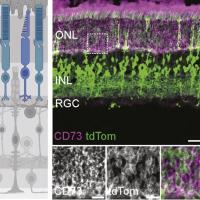
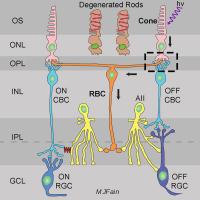
A new study funded by the National Eye Institute shows that certain retinal cells can rewire themselves when vision begins to deteriorate in retinitis pigmentosa, a genetic eye disease that leads to progressive blindness.
A new National Eye Institute-supported study identifies a possible way to slow or block progression of age-related macular degeneration (AMD), a leading cause of blindness in people over age 50.
National Institutes of Health (NIH) scientists have developed a new surgical technique for implanting multiple tissue grafts in the eye's retina. The findings in animals may help advance treatment options for dry age-related macular degeneration.
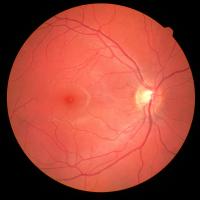
In a new National Institutes of Health-funded study led by scientists at the Wilmer Eye Institute, Johns Hopkins Medicine researchers say they have determined that low blood sugar, or hypoglycemia, may promote a breakdown of the blood-retinal barrier.