We've launched in the 2027-2032 strategic planning process. Help identify emerging opportunities for NEI to achieve our mission.
- Read our Request for Information
- Have a question? Email us at NEIPlan@mail.nih.gov
Planning Process
Throughout the 2026-2031 strategic planning process, we are seeking community input. NEI is actively welcoming stakeholder input by:
- Issuing a Request for Information (RFI) for perspectives on research needs. NEI issued this RFI to researchers, clinicians, patient advocates, professional societies, and the public. Submit feedback to the RFI by April 15, 2026.
- Hosting expert panels. These panels will examine traditional vision research disciplines and ways to capitalize on emerging scientific opportunities in alignment with the NIH Unified Strategy, across four core pillars: Foundational Science, Translational Science, Clinical & Population Science, and Training and Metascience. The plan will capture high-level takeaways from panel discussions on the state of the science, bold predictions for the future, and vision research needs, gaps, and opportunities.
- Hosting a webinar. Watch our March 18, 2026 webinar on the 2026-2031 NEI Strategic Plan here:

Download the 2021-2026 Plan
Our current strategic plan is being implemented through 2026. NEI is currently updating the strategic plan to ensure it is aligned with the current Administration's priorities and complies with this Administration's Executive Orders. The updated version will be posted once available.
Accompanying Editorials
Concomitant with the release of this plan, we also published a series of 5 editorials in leading vision journals to elaborate on several aspects of this Strategic Plan:
- Ophthalmology
- JAMA Ophthalmology
- Investigative Ophthalmology & Visual Science
- American Journal of Ophthalmology
- Optometry & Vision Science
Areas of Emphasis
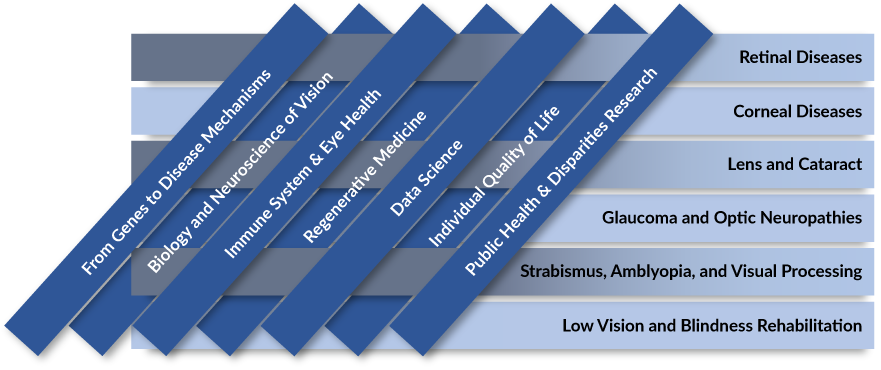
NEI’s strategic plan includes 7 areas of emphasis that represent challenges impacting multiple facets of vision science. Note that these areas don’t replace the existing core program structure at NEI. Instead, they highlight important perspectives and expertise — particularly in evolving areas that will require collaboration across disciplines.