Thanks to the work of NEI scientists and grantees, we’re constantly learning new information about the causes and treatment of vision disorders. Get the latest updates about their work — along with other news about NEI.
Researchers at the University of New Hampshire have created a hydrogel that could one day be made into a contact lens to more effectively treat corneal melting.
“Our data suggest that the two eyes are merged as they arrive in the neocortex and not at a later stage of brain processing, as previously believed,” said Vanderbilt’s Alexander Maier, assistant professor of psychology.
Using a novel patient-specific stem cell-based therapy, researchers at the National Eye Institute (NEI) prevented blindness in animal models of geographic atrophy, the advanced “dry” form of age-related macular degeneration (AMD)...
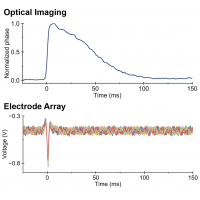
Researchers at Stanford University, Palo Alto, California, have created a noninvasive technology that detects when nerve cells fire based on changes in shape.
Dr. Okihide Hikosaka, senior investigator at the National Eye Institute (NEI) Laboratory of Sensorimotor Research, is a recipient of the 2018 Gruber Prize in Neuroscience.
A new form of therapy may halt or even reverse a form of progressive vision loss, spinocerebellar ataxia type 7 (SCA7). This new therapy has the potential to treat neurogenetic diseases effectively and with far fewer side effects than other medications.
Researchers funded by the National Eye Institute (NEI) have reversed congenital blindness in mice by changing supportive cells in the retina called Müller glia into rod photoreceptors.
Inspired by tiny nanostructures on transparent butterfly wings, engineers at Caltech have developed a synthetic analogue for eye implants that makes them more effective and longer-lasting.