Thanks to the work of NEI scientists and grantees, we’re constantly learning new information about the causes and treatment of vision disorders. Get the latest updates about their work — along with other news about NEI.
Researchers at the National Eye Institute (NEI) are launching a clinical trial to test the safety of a novel patient-specific stem cell-based therapy to treat geographic atrophy, the advanced “dry” form of age-related macular degeneration.
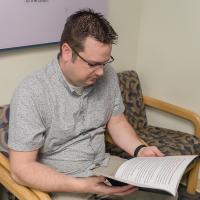
Results from a clinical trial funded by the National Eye Institute (NEI) show that while vision therapy can successfully treat convergence insufficiency (CI) in children, it fails to improve their reading test scores.
Researchers at the University of Illinois at Chicago are the first to identify the presence of a specific type of antibody, called anti-citrullinated protein autoantibodies, or ACPAs, in human tear fluid.
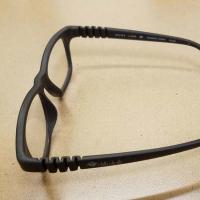
A team of University of Arizona researchers has received a five-year, $4.1 million grant to study whether using eyeglasses to correct astigmatism in toddlers improves language, cognitive and motor development.
A study from the University of Pennsylvania suggests efforts in the past decade to reduce the invasiveness and recovery time for ocular procedures have not impacted opioid use.
Methotrexate and the more expensive mycophenolate mofetil performed similarly in a head-to-head clinical trial that compared the two drugs for treating noninfectious uveitis, an eye disease that accounts for up to 15% of blindness in the U. S.
With a $1.8 million research grant sponsored by the National Eye Institute, UH optometrist Lisa Ostrin is examining why an ever-increasing number of youngsters need glasses.
A large-scale, collaborative, systems biology approach is needed to expedite the discovery of treatments for dry age-related macular degeneration (AMD) – a leading cause of blindness among people 65 and older for which is there is no treatment.
Children can keep full visual perception – the ability to process and understand visual information – after brain surgery for severe epilepsy, according to a study funded by the National Eye Institute (NEI), part of the National Institutes of Health.