Thanks to the work of NEI scientists and grantees, we’re constantly learning new information about the causes and treatment of vision disorders. Get the latest updates about their work — along with other news about NEI.
An international coalition of eye researchers used machine learning to develop classification criteria for 25 of the most common types of uveitis, a collection of over 30 diseases characterized by inflammation inside the eye.
As regenerative therapies for blinding diseases move closer to clinical trials, the NEI's functional imaging consortium is pioneering noninvasive technologies to monitor the function of the retina’s neurons and their connections to the brain.
LambdaVision, the Farmington, Connecticut-based biotech firm that developed the artificial retina, is exploring optimizing production of an artificial retina in space, in a series of missions to the International Space Station.
Early treatment with anti-VEGF injections slowed diabetic retinopathy in a clinical study from the DRCR Retina Network (DRCR.net). However, two years into the four-year study its effect on vision was similar to standard treatment.
The National Eye Institute (NEI) Data Commons now enables researchers to access data from patients with macular degeneration who participated in the Age-related Eye Disease Study 2 (AREDS2).
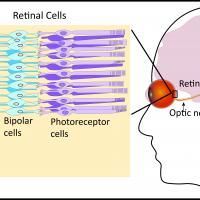
A team led by scientists at the National Eye Institute (NEI) has noninvasively visualized the light-sensing cells in the back of the eye, known as photoreceptors, in greater detail than ever before.
Scientists at the National Eye Institute (NEI) have developed a promising gene therapy strategy for a rare disease that causes severe vision loss in childhood.
Researchers at the National Eye Institute (NEI) report that a brain region in the superior temporal sulcus (fSTS) is crucial for processing and making decisions about visual information.
Children who undergo cataract surgery as infants have a 22% risk of glaucoma 10 years later, whether or not they receive an intraocular lens implant. The findings come from the National Eye Institute (NEI)-funded Infant Aphakic Treatment Study.