Beginning in late July, NIH will start introducing a new website experience designed to make it easier to find health information, research, funding opportunities, and other resources. During the transition, you may notice changes to navigation, page layouts, and where some information is located. Learn more in our Frequently Asked Questions.
Thanks to the work of NEI scientists and grantees, we’re constantly learning new information about the causes and treatment of vision disorders. Get the latest updates about their work — along with other news about NEI.
Children who undergo cataract surgery as infants have a 22% risk of glaucoma 10 years later, whether or not they receive an intraocular lens implant. The findings come from the National Eye Institute (NEI)-funded Infant Aphakic Treatment Study.
Children wearing multifocal contact lenses had slower progression of their myopia, according to results from a clinical trial funded by the National Eye Institute, part of the National Institutes of Health.
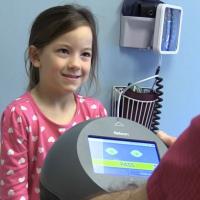
The NEI has funded development of a handheld pediatric vision scanner that easily and accurately screens for amblyopia, or “lazy eye.” The device could facilitate earlier identification of children who need vision-saving treatment.
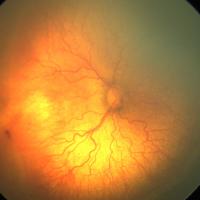
Babies born prematurely who require treatment to prevent blindness from retinopathy of prematurity (ROP) could be treated with a dose of Avastin (bevacizumab) that is a fraction of the dose commonly used for ROP currently.
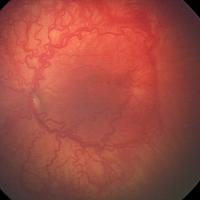
An artificial intelligence (AI) device that has been fast-tracked for approval by the Food and Drug Administration may help identify newborns at risk for aggressive posterior retinopathy of prematurity (AP-ROP). AP-ROP is the most severe form of ROP.
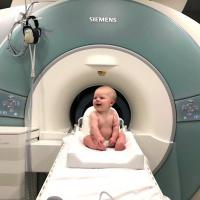
According to a study from Emory University, as young as six days a baby’s brain appears hardwired for the specialized tasks of seeing faces and seeing places.
An artificial intelligence algorithm that can detect a potentially devastating cause of childhood blindness better than most human experts has been granted breakthrough status by the FDA.
Results from a clinical trial funded by the National Eye Institute (NEI) show that while vision therapy can successfully treat convergence insufficiency (CI) in children, it fails to improve their reading test scores.
A team of University of Arizona researchers has received a five-year, $4.1 million grant to study whether using eyeglasses to correct astigmatism in toddlers improves language, cognitive and motor development.
With a $1.8 million research grant sponsored by the National Eye Institute, UH optometrist Lisa Ostrin is examining why an ever-increasing number of youngsters need glasses.