NIH is moving the launch of its new website to the fall to ensure the best possible experience for everyone who relies on our websites for health information, research, funding opportunities, and other resources. Get the Latest Updates and FAQs
Thanks to the work of NEI scientists and grantees, we’re constantly learning new information about the causes and treatment of vision disorders. Get the latest updates about their work — along with other news about NEI.
The Knights Templar Eye Foundation has awarded two NEI scientists grants to research inherited retinal degenerations, diseases that can cause blindness in early childhood.
A new study shows that the complement system, part of the innate immune system, plays a protective role to slow retinal degeneration in a mouse model of retinitis pigmentosa, an inherited eye disease.
Researchers at the University of California, Berkeley, find that restoring opsins with gene therapy can make 'blind' cells light-sensitive; potential human treatment within three years.
A new therapy developed by researchers at the University of California, Berkeley, could help prolong useful vision and delay total blindness for people with retinitis pigmentosa.
The National Eye Institute (NEI) awarded $25,000 to a team led by Wei Liu, Ph.D., Albert Einstein College of Medicine, for demonstrating progress toward the development of a living model of the human retina...
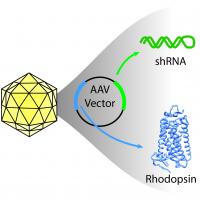
Scientists funded by the National Eye Institute (NEI) report a novel gene therapy that halts vision loss in a canine model of a blinding condition called autosomal dominant retinitis pigmentosa (adRP).
Researchers funded by the National Eye Institute (NEI) have reversed congenital blindness in mice by changing supportive cells in the retina called Müller glia into rod photoreceptors.
Immune cells called microglia can completely repopulate themselves in the retina after being nearly eliminated, according to a new study in mice from scientists at the National Eye Institute (NEI).
Silencing a gene called Nrl in mice prevents the loss of cells from degenerative diseases of the retina, according to a new study. The findings could lead to novel therapies for preventing vision loss from human diseases such as retinitis pigmentosa.