Skip to content

NEI Research News

Thanks to the work of NEI scientists and grantees, we’re constantly learning new information about the causes and treatment of vision disorders. Get the latest updates about their work — along with other news about NEI.

Source
472 items
Side-by-side panels showing retinal vessels. Left panel filled with green, right panel much less green.

Faulty molecular master switch may contribute to AMD

A signaling pathway controlled by transforming growth factor β (TGF-β) could be involved in the progression of age-related macular degeneration (AMD).
Grantee News

Findings on eye-signal blending re-examine Nobel-winning research

“Our data suggest that the two eyes are merged as they arrive in the neocortex and not at a later stage of brain processing, as previously believed,” said Vanderbilt’s Alexander Maier, assistant professor of psychology.
Grantee News

Team finds how error and reward signals are organized within cerebral cortex

A Vanderbilt University team recently described how error and reward signals are organized within the cerebral cortex.
Woman

The 17 different ways your face conveys happiness

Human beings can configure their faces in thousands and thousands of ways to convey emotion, but only 35 expressions actually get the job done across cultures, a new study has found.
Grantee News

Brain plasticity restored in adult mice through targeting specific nerve cell connections

Neuroscientists have discovered a new molecular mechanism that is essential for maturation of brain function and may be used to restore plasticity in aged brains.
Grantee News

Thriving on teamwork: new research shows how brain cells filter information in groups

Salk discovery could help to better understand how neurons work together in networks to shape our perceptions of the world.
Grantee News

300 Blind Mice Uncover Genetic Causes of Eye Disease

Hundreds of new genes linked to blindness and other vision disorders have been identified in a screen of mouse strains. Many of these genes are likely important in human eye vision and the results could help identify new causes of hereditary blindness.
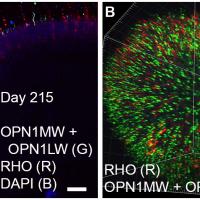
Multiphoton images show the outer segments of cone and rod photoreceptor cells in 215-day retinal organoids. Immunostaining shows a marker for cones (green) and rods (red). The “A” view shows optical sections; “B” is a reconstructed three-dimensional view.

NEI Awards Prize for Progress Toward Developing Lab-Made Retinas

The National Eye Institute (NEI) awarded $25,000 to a team led by Wei Liu, Ph.D., Albert Einstein College of Medicine, for demonstrating progress toward the development of a living model of the human retina...
A scale with left superior colliculus neurons more activated on left and right superior colliculus neurons less activated on the right, and scale weighed down to the left. Needle on scale points to “yes”, meaning detection of relevant event.

NIH researchers discover neural code that predicts behavior

Scientists at the National Eye Institute (NEI) have found that neurons in the superior colliculus, an ancient midbrain structure found in all vertebrates, are key players in allowing us to detect visual objects and events.
Images show multimodal technique using adaptive optics and angiography to simultaneously see photoreceptors (left), retinal pigment epithelial cells (center), and choriocapillaris in the living human eye.

NIH scientists combine technologies to view the retina in unprecedented detail

By combining two imaging modalities—adaptive optics and angiography—investigators at the National Eye Institute (NEI) can see live neurons, epithelial cells, and blood vessels deep in the eye’s light-sensing retina.