Thanks to the work of NEI scientists and grantees, we’re constantly learning new information about the causes and treatment of vision disorders. Get the latest updates about their work — along with other news about NEI.
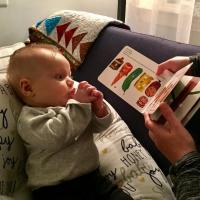
Shortly after birth when the world is a blur, babies may be learning to identify patterns.According to a new study funded by the National Eye Institute (NEI), the initial phase of blurry vision may be fundamental to the development of normal visual...
Dr. Okihide Hikosaka, senior investigator at the National Eye Institute (NEI) Laboratory of Sensorimotor Research, is a recipient of the 2018 Gruber Prize in Neuroscience.
The National Eye Institute (NEI), part of the National Institutes of Health, has awarded grants to five multi-disciplinary teams to develop new disease models for a range of eye conditions.
Vision researcher, T. Michael Redmond, Ph.D., chief of the National Eye Institute (NEI) Laboratory of Retinal Cell and Molecular Biology, is a recipient of the 2018 António Champalimaud Vision Award for foundational science discoveries about the molecular
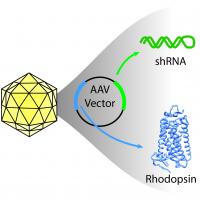
Scientists funded by the National Eye Institute (NEI) report a novel gene therapy that halts vision loss in a canine model of a blinding condition called autosomal dominant retinitis pigmentosa (adRP).
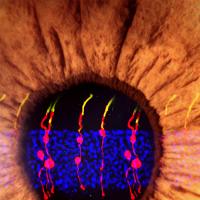
Researchers funded by the National Eye Institute (NEI) have reversed congenital blindness in mice by changing supportive cells in the retina called Müller glia into rod photoreceptors.
Scientists have evidence that variants of the same gene that enables us to make connective tissue by crosslinking proteins is associated with unusual glaucoma.
National Eye Institute (NEI) Postdoctoral Fellow Aman George, Ph.D., has received a $65,000 grant from the Knights Templar Eye Foundation to identify new drug treatments for vision impairment in children with a type of albinism.