Thanks to the work of NEI scientists and grantees, we’re constantly learning new information about the causes and treatment of vision disorders. Get the latest updates about their work — along with other news about NEI.
A new National Eye Institute-funded study in mice shows that if the retina of the amblyopic eye is temporarily and reversibly anesthetized just for a couple of days, the brain’s visual response to the eye can be restored even in adulthood.
Ten teams are being recognized for their proof-of-concept ideas following Phase 1 of the Data Sharing Index (“S-Index”) Challenge, an NIH competition aimed at incentivizing data sharing
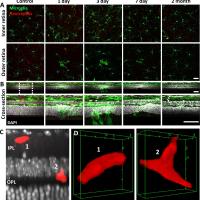
During most eye infections or injuries, neutrophils, immune cells found in the blood, are usually the first line of defense. However, new research shows retina responds differently than other tissues in the body.
A National Eye Institute-funded research team at the University of Minnesota Medical School discovered that a cancer signaling pathway has previously unrecognized roles in retina and brain blood vessels.
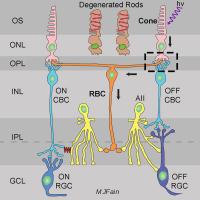
A new study funded by the National Eye Institute shows that certain retinal cells can rewire themselves when vision begins to deteriorate in retinitis pigmentosa, a genetic eye disease that leads to progressive blindness.
A new National Eye Institute-supported study identifies a possible way to slow or block progression of age-related macular degeneration (AMD), a leading cause of blindness in people over age 50.
Researchers at the National Institutes of Health (NIH) have identified which brain circuits are vital for visual acuity and how they are affected by damaged retinal cells.
Brown University researchers have identified a promising new approach that may help to restore vision in people affected by macular degeneration and other retinal disorders.
New studies in rats suggest the drug reserpine, approved in 1955 for high blood pressure, might treat the blinding disease retinitis pigmentosa. No therapy exists for this rare inherited disease, which starts affecting vision from childhood.